Skip to content

Popular Keywords

Categories

Total Results

No Record Found

View All Results
Youtube Facebook Threads Instagram Twitter Linkedin Reddit Medium
360Onhistory
  • About
    • Privacy Policy
  • Science
  • History
  • Nature-Environment
  • Climate Change
  • Blog Posts
  • Videos
  • Podcast
  • Fantastic Women
  • Conspiracy Theories
  • About
    • Privacy Policy
  • Science
  • History
  • Nature-Environment
  • Climate Change
  • Blog Posts
  • Videos
  • Podcast
  • Fantastic Women
  • Conspiracy Theories

Day: July 13, 2023

James Webb Telescope celebrates its first year with stunning image
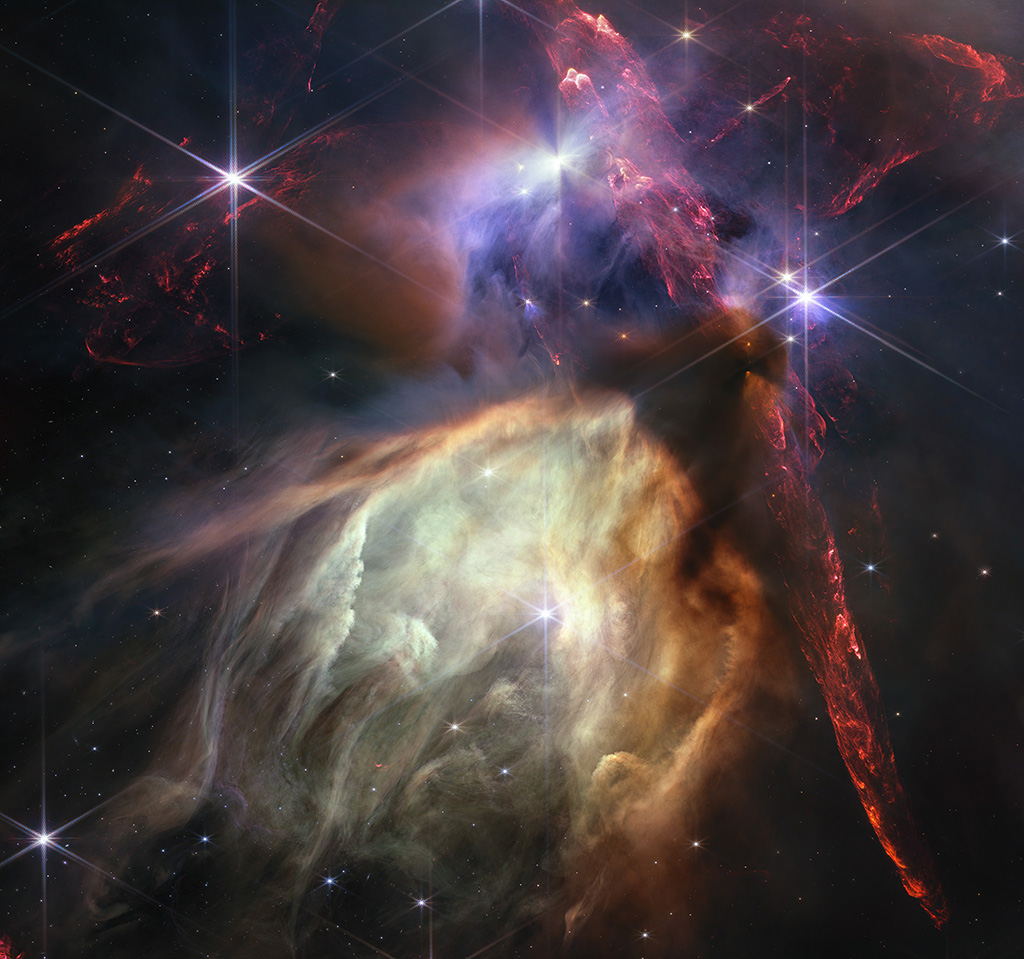
An active star-forming region. Red dual opposing jets coming from young stars fill the darker top half of the image, while a glowing pale-yellow, cave-like structure is bottom center, tilted toward two o’clock, with a bright star at its center. The dust of the cave structure becomes wispy toward eight o’clock, trailing off and allowing stars and distant galaxies to show through. Above the arched top of the dust cave three groupings of stars with diffraction spikes are arranged. Smaller stars are scattered around the image. A dark cloud sits at the top of the arch of the glowing dust cave, with one streamer curling down the right-hand side. The dark shadow of the cloud appears pinched in the center, with light emerging in a triangle shape above and below the pinch, revealing the presence of a star inside the dark cloud. The image’s largest jets of red material emanate from within this dark cloud, thick and displaying structure like the rough face of a cliff, glowing brighter at the edges. At the top center of the image, a star displays another, larger pinched dark shadow, this time vertically. To the left of this star is a more wispy, indistinct region, like this star is also beginning to clear out space around itself like the one at the center of the dusty cave below.

James Webb Telescope celebrates its first year with stunning image that has been released by NASA. It shows a star-forming region in Rho Ophiuchi cloud complex

We just found a rare white dwarf pulsar

Artist's impression of a white dwarf pulsar. In this binary star system, a rapidly spinning white dwarf (right) accelerates electrons to nearly the speed of light. These high-energy particles produce bursts of radiation that strike the accompanying red dwarf star (left), causing the entire system to pulsate from the radio to the X-ray range. Credit: M. Garlick/University of Warwick/ESO

We just found a rare white dwarf pulsar. The discovery of J1912-4410 – just 773 light-years away from Earth provides new insight into how stars evolve.

Copyright © 2026 360onhistory

Website design by DoLocal Digital Marketing Agency