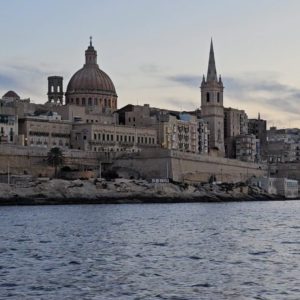
I just visited this gorgeous place, full of history, culture and nature, so here is a photoblog and some information about this Mediterranean archipelago.
Malta, a tiny southern European island country is located in the Mediterranean Sea between Sicily and North Africa. It is really an archipelago with Valletta as its capital. An area of 316 km2 (122 sq mi) makes it the smallest country by area in the world, home to a population of 542,000.


Jean de Valette, the Grand Master of the Knights of St John, led Malta’s defence during the Great Siege of 1565 against the Ottomans. He later founded Valletta, Malta’s capital, named in his honour.


History
This small island nation has been populated since almost 6000 BC, its location right in the middle of the Mediterranean probably giving it geostrategic importance over the millennia. This has meant that a succession of cultures have ruled over it, including the Phoenicians, Carthaginians, Greeks, and Romans in antiquity; the Arabs, Normans, and Aragonese during the Middle Ages; and the Knights Hospitaller, French, and British in the modern era. Amongst all of these, it is the Knights Hospitaller or the Knights of St John, a catholic order that have left the most profound impressions of their presence.
But before all of them, there were even more ancient people who lived there. No one knows who they were but they left some absolutely fascinating examples of megalithic structures, strewn all over Malta. European Neolithic agriculturists or perhaps stone age hunters left behind pottery since at least 5200 BC. This pottery is similar to others found in Italy, indicating that they may have arrived from there. Subsequently, a new cutlure either arose from these people or supplanted them.
Around 3500 BC, these inhabitants of the Maltese Islands were constructing some of the world’s oldest free-standing structures. These megalithic temples, such as Ġgantija on Gozo and Ħaġar Qim and Mnajdra on Malta, are characterised by their distinctive trefoil design. They were probably used for religious purposes from 4000 to 2500 BC. There are many others found all over the islands, especially on the main island (Malta).


Evidence suggests that animal sacrifices were offered to a goddess of fertility, whose statue is now on display in the National Museum of Archaeology in Valletta. Another intriguing feature of the Maltese landscape is a network of parallel grooves known as “cart ruts.” These may have been created by wooden-wheeled carts carving into the soft limestone over time.


The culture that built these amazing structures mysteriously disappeared around 2500 BC, possibly due to factors like famine or disease. And after them the Maltese islands remained unpopulated several decades until the arrival of Bronze Age immigrants. These people left behind evidence showing that they cremated their dead and introduced smaller megalithic structures called dolmens. It is thought that they belonged to a completely different population from the one that built the megalithic temples. And it seems that they also arrived from Sicily because of the similarity of Maltese dolmens to some small constructions found there.
Around 1000 BC the Pheonicians arrived, using Malta as a stop on their trade routes from the eastern Mediterranean to Cornwall in the UK. They made an area called Mdina as their base. After Phoenicia fell in 332 BC, Carthage controlled Malta and at this time the people of Malta cultivated olives and carob (a legume) and produced textiles. Then came the Romans. Emperor Hadrian turned it into a municipium (a free town). As the Roman empire declined and fell, Malta also saw ups and downs. It was ruled by Vandals, Ostrogoths and then the Byzantine Empire, which introduced Greek families into the Maltese population.


The Arabs comprising of North African Aghlabids then invaded leaving it practically uninhabited until it was recolonised by another group of Arabs from Sicily in 1048–1049. These Arabs initiated an agricultural revolution introducing new irrigation, cotton, and some fruits. Most importantly, the Siculo-Arabic language filtered into the island from Sicily; eventually evolving into the Maltese language.
The Normans followed the Arabs in 1091. There is a myth that the Norman leader, Roger I of Sicily, was welcomed by Christian captives and he tore off a portion of his checkered red and white banner and presented it to the Maltese in gratitude for having fought on his behalf. And this formed the basis of the modern flag of Malta. However, there is no evidence that this myth is true.
Being in the midst of the Mediterranean, Malta kept changing hands, falling under different rulers and invaders. The French and British followed and Malta became part of the British Empire in 1814. It was a strategic location for the British, halfway between Gibraltar and Egypt. This made it an important stop for ships traveling to India.
Malta achieved its independence as the State of Malta on 21 September 1964. Under its 1964 constitution, Malta initially retained Elizabeth II as Queen of Malta and thus head of state, with a governor-general exercising executive authority on her behalf. In 1971, the Malta Labour Party won the general elections, resulting in Malta declaring itself a republic on 13 December 1974 within the Commonwealth.
The name Malta likely originates from the Phoenician word “Maleth”, meaning “haven” or “shelter,” reflecting its safe harbours. The Greeks later called it Melita, possibly derived from “meli” (honey), due to the island’s honey production. The Romans retained this name, while the Arabs adapted it during their rule, eventually evolving into the modern Malta. This history highlights Malta’s rich cultural influences over time.
Christian Roots
Malta has strong links to Christianity because it is believed that in AD 58, Paul the Apostle and Luke the Evangelist were shipwrecked on the islands. The Knights Hospitaller also made it their base between 1530–1798. The Order of Knights of the Hospital of Saint John of Jerusalem commonly known as the Knights Hospitaller is a Catholic military order, founded in the crusader Kingdom of Jerusalem in the 12th century and had headquarters there until 1291. Among various other places it was headquartered in Malta between 1530–1798, leaving behing its indelible mark on the nation. You can see their legacy everywhere.


The Three Cities
The Three Cities of Malta—Vittoriosa (Birgu), Senglea (L-Isla), and Cospicua (Bormla)—are historic fortified towns located across the Grand Harbour from Valletta. These cities served as the first home of the Knights of St John in the 16th century and played a key role in Malta’s defence, particularly during the Great Siege of 1565 and World War II. Vittoriosa is renowned for its maritime history, featuring the Inquisitor’s Palace and the Fort St Angelo. Senglea offers stunning views from its Gardjola Gardens, while Cospicua is known for its double fortifications.


Culture
Malta is a cultural mosaic – a rich blend of influences shaped by centuries of occupation by various civilisations. Because the island’s strategic location in the Mediterranean brought together Phoenicians, Romans, Arabs, Normans, the Knights of St John, French, and British, each of them left a unique mark on the nation. This is evident in the Maltese language, a Semitic tongue with Romance elements, and in the architecture, which ranges from Arabic-style balconies to Baroque churches. The cuisine fuses Mediterranean and North African flavours, with dishes like pastizzi and fenkata, While traditional festas showcase the Catholic heritage, there is also the influence of modern art and music, reflecting a fusion of global and local trends.


The Iconic Balconies
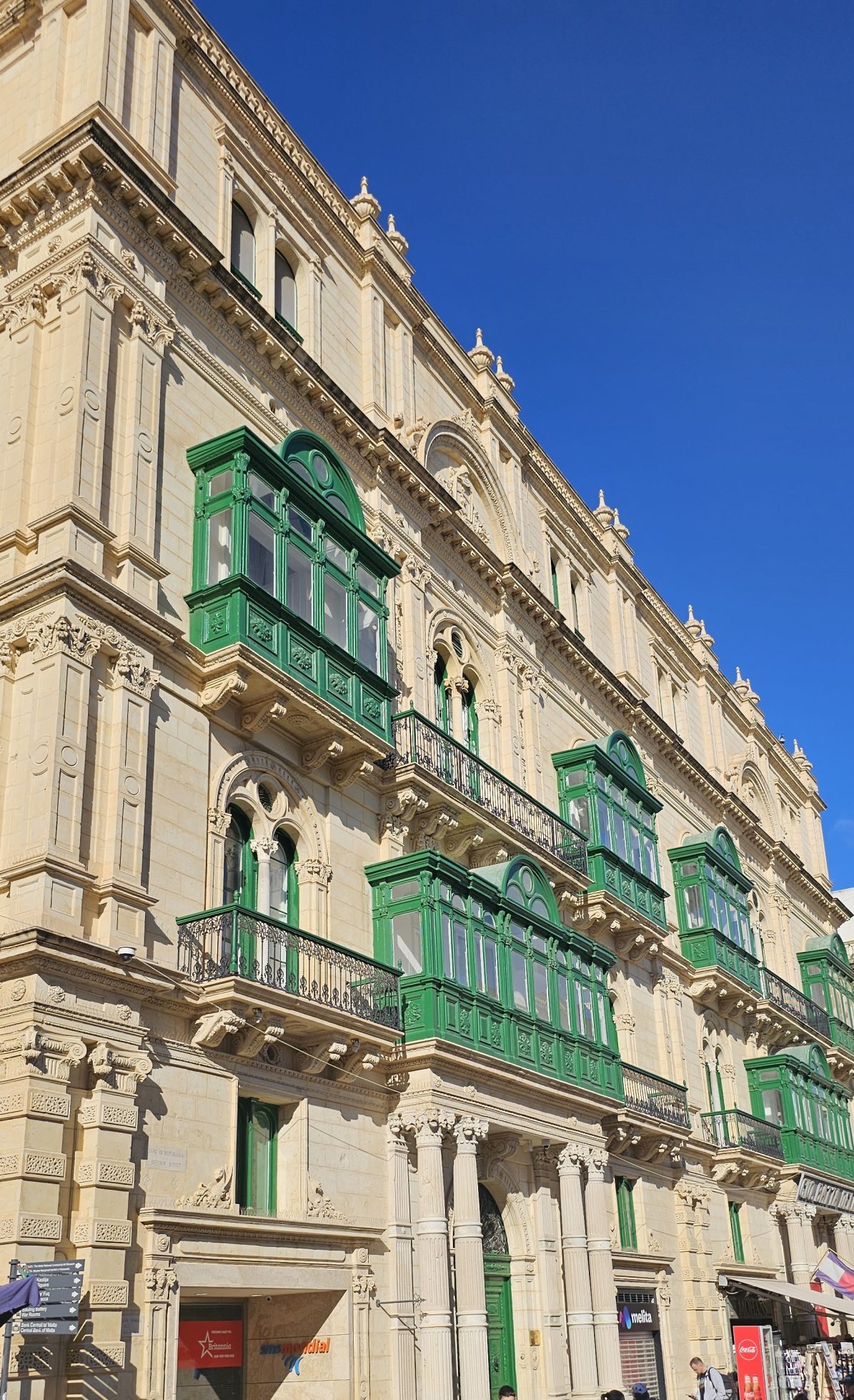
One of the most fascinating iconic features of Maltese architecture are the traditional balconies known as gallarija. These enclosed wooden or stone structures are often brightly painted, and can be seen outside many historic homes. They were introduced during the period of the Knights of St John but are influenced by North African and Arabic mashrabiya designs. These were later adapted to suit the Baroque architectural style popular under the Knights, blending practicality with aesthetic appeal.They serve both practical and decorative purposes, offering ventilation, natural light, and a space to observe street life discreetly. They are another example reflecting Malta’s cultural blend, because they have influences from Arabic, Baroque, and British architectural styles. They do add charm and character to its towns and cities and you can’t help stopping and admiring them. They reminded me of south asian jharokas ( a stone window projecting from the wall face of a building, in an upper story, overlooking a street, market, court or any other open space).
The Story of Carvaggio
Michelangelo Merisi da Caravaggio, the painter, came to Malta in 1607 seeking refuge and a fresh start after fleeing Rome, where he was wanted for murder. He sought the protection of the Knights of St John, hoping to restore his reputation. During his time in Malta, he was knighted for his artistic contributions, including works like The Beheading of Saint John the Baptist. However, he got into trouble again, which led to his imprisonment and eventual escape from the island.

Nature
Malta is an archipelago with three main islands: Malta, Gozo, and Comino, and its natural environment is characterised by its rugged coastline, stunning cliffs, and clear Mediterranean waters. The islands have gorgeous limestone landscapes, quiet, gorgeous beaches, and hidden coves, along with a variety of endemic flora and fauna, some not found anywhere else. While urbanisation has shaped much of the country, rural areas still have terraced fields, small woodlands, and protected nature reserves like Għadira.


Although it is small as compared to other countrues, it really has such a rich history, combined with a stunning and diverse natural environment, and a unique culture, which means that there is so much to absorb when you visit.
I thoroughly enjoyed my visit and was pleasantly surprised at its richness.