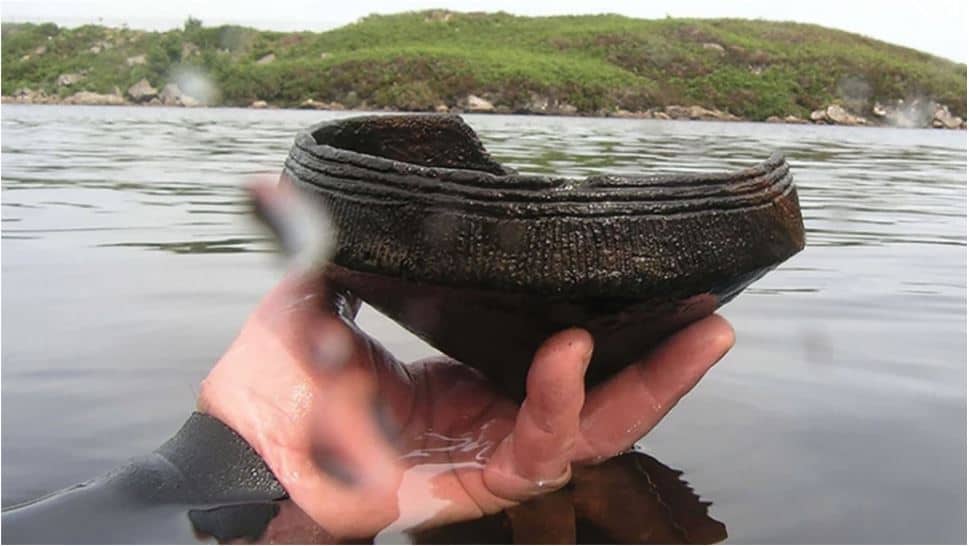
Artificial, human made islets known as crannogs, can be found all across Scotland. Traditionally, they were dated to no earlier than the Iron Age (800 BC), however latest research of several Outer Hebridean Neolithic crannogs has demonstrated that crannogs were a widespread feature of the Neolithic (after 4000 BC), with some of the new islands dating back to 3,700 BC. They may have been special locations, based on the finding of material culture in the surrounding water. These findings suggest that other ‘undated’ crannogs across Scotland and Ireland could potentially have Neolithic origins.
The study was published in Cambridge Core (© Antiquity Publications Ltd, 2019).
Garrow, D., & Sturt, F. (2019). Neolithic crannogs: Rethinking settlement, monumentality and deposition in the Outer Hebrides and beyond. Antiquity, 93(369), 664-684. doi:10.15184/aqy.2019.41