It used to be a planet and then it wasn’t. Pluto’s demotion to a dwarf planet has been a bone of contention amongst many. This fight has overshadowed a milestone in human space travel. We have actually sent a spacecraft that has flown by Pluto, has made scientific observations and sent back images that have changed our understanding of this solar system object.

How was it discovered?
In the 1840s, astronomers noticed that the orbit of Uranus was being disturbed by something other than Neptune and the hunt for a ninth planet was started. The job of locating this Planet X was given to a 23-year-old astronomer Clyde W Tombaugh, at the Lowell Observatory in Flagstaff, Arizona. He had to systematically image the night sky in pairs of photographs and then examine them to see if any objects had moved. After nearly a year of this, Tombaugh noticed an object that seemed to have moved on photographs taken on January 23 and 29, 1930. He had discovered Pluto, subsequently confirmed with further photographic evidence.

(Check out What is a Blackhole?)
How did it come to be called Pluto?
Amidst a lot of discussion around its name, an 11-year-old girl from Oxford, England, called Venetia Burney, suggested the name. Pluto is the Roman God of the underworld and she was interested in classical mythology. Venetia’s grandfather was a former librarian at the Bodleian Library in Oxford and he forwarded the name to an astronomy professor there, who then sent it colleagues in the US. Lowell Observatory members voted unanimously to select the name Pluto. From then on, until 2006, we had nine planets in the solar system with Pluto being the farthest from the Sun.
What is it like?
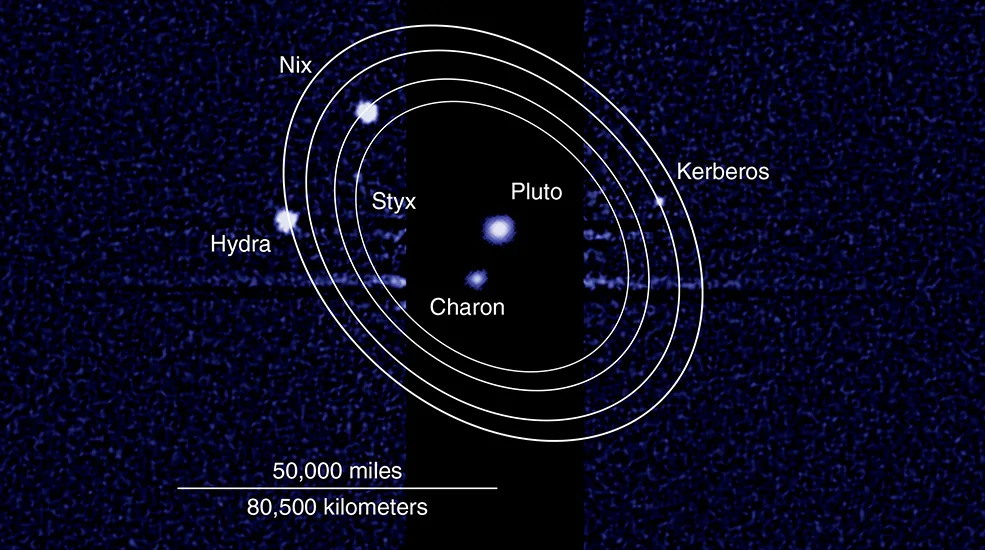
It is smaller than our moon at 2,380 km wide and orbits the Sun from a distance of 5.8 billion km in a region known as the Kuiper Belt. A year on Pluto is 248 Earth years, and a day there lasts 153 hours or about six Earth days. Because it is so far away, Pluto has yet to complete a full orbit of the Sun since its discovery. Unlike other planets from Jupiter and beyond, it does not have a ring system but it does have five moons called Styx (discovered 2012), Nix (discovered in 2005), Hydra (discovered in 2005), Kerberos (discovered in 2011) and Charon (discovered in 1978), all named after mythological figures associated with the underworld.
Fun fact: According mythology, Kerberos is the three-headed dog of the underworld, depicted as fluffy in Harry Potter and the Philosopher’s Stone.

(Uranus – The Tilted Planet)
The largest moon, Charon, is so big that Pluto and Charon orbit each other like a double planet. Pluto is a cold world with surface temperatures from -228 to -238 C; far too cold, to sustain life as we know it.

The dwarf planet and its system live in the Kuiper Belt, a disc in the outer solar system beyond Neptune, composed primarily of icy objects. Pluto is also known as a Trans Neptunian Object, which are minor planets or dwarf planets that orbit the Sun at a greater average distance than Neptune does.

Pluto is the largest known Kuiper Belt Object and like other members of the Kuiper Belt, it is thought to be a residual planetesimal; a component of the protoplanetary gas and dust disc around the Sun that failed to become a full-fledged planet. Astronomers also think that its current position is due to a sudden migration by Neptune early in the Solar System’s formation.
So, here is Pluto, pretending to be a planet, orbiting along and then comes the International Astronomical Union (IAU), which says that Pluto has not met one of its three criteria to be classified as a planet. According to them, a planet is a body in the solar system that orbits the Sun, has sufficient mass to give it a rounded shape and has cleared its neighborhood of other object. Pluto has done two of these. It has not cleared its orbital path of other objects, so in 2006 it was demoted to a dwarf planet. The discovery of several similar objects in the Kuiper Belt, including dwarf planet Eris, which were similar to Pluto, led to the IAU redefining planets and questioning Pluto’s status.
To most people, Pluto might be famous because of this demotion, but its real claim to fame is that we have sent just one spacecraft in that direction and this spacecraft has flown by Pluto, making scientific observations and taking images. NASA launched its New Horizons spacecraft on January 19, 2006 from Cape Canaveral Air Force Station, on an Atlas V rocket. At that time, it was the fastest human-made object ever launched from Earth. After a brief encounter with an asteroid, New Horizons reached Jupiter a year later, which provided a gravity assist to increase its speed. Its instruments were also tested, returning data about Jupiter’s atmosphere, moons, and magnetosphere. It spent the next seven years in hibernation mode and was brought back online on December 6, 2014. I remember watching this on NASA TV and it was terribly exciting. On January 15, 2015, the spacecraft began its approach to Pluto and on July 14, 2015, it became the first spacecraft to explore the dwarf planet, when it flew 12,500 km above its surface. It sent back the last of its recorded data from Pluto on October 25, 2016, before moving on to other Kuiper Belt Objects.
(Jupiter: Solar System’s Giant)
Before New Horizons, the earliest maps of Pluto, made in the late 1980s, were created from close observations of eclipses by its moon, Charon, allowing scientists to record the change in the total average brightness of the Pluto-Charon system during the eclipses.

What did New Horizons tell us?
It made Pluto so much clearer, when it imaged all of its northern hemisphere and equatorial regions down to about 30° south. It also made detailed measurements and observations of Pluto and its moons. The dwarf planet’s surface is composed of 98 percent nitrogen ice, methane and carbon monoxide and is quite varied, with large differences in both brightness and color. The color varies from charcoal black, to dark orange and white.

Pluto’s notable geographical features include Tombaugh Regio, or the “Heart“, (which is a large bright area on the side opposite the moon Charon), Cthulhu Macula, or the “Whale” (a large dark area on the trailing hemisphere), and the “Brass Knuckles” (a series of equatorial dark areas on the leading hemisphere). Sputnik Planitia, the western lobe of the “Heart”, is a 1,000 km-wide basin of frozen nitrogen and carbon monoxide ices, divided into cells, and there are obvious signs of glacial flows both into and out of the basin.

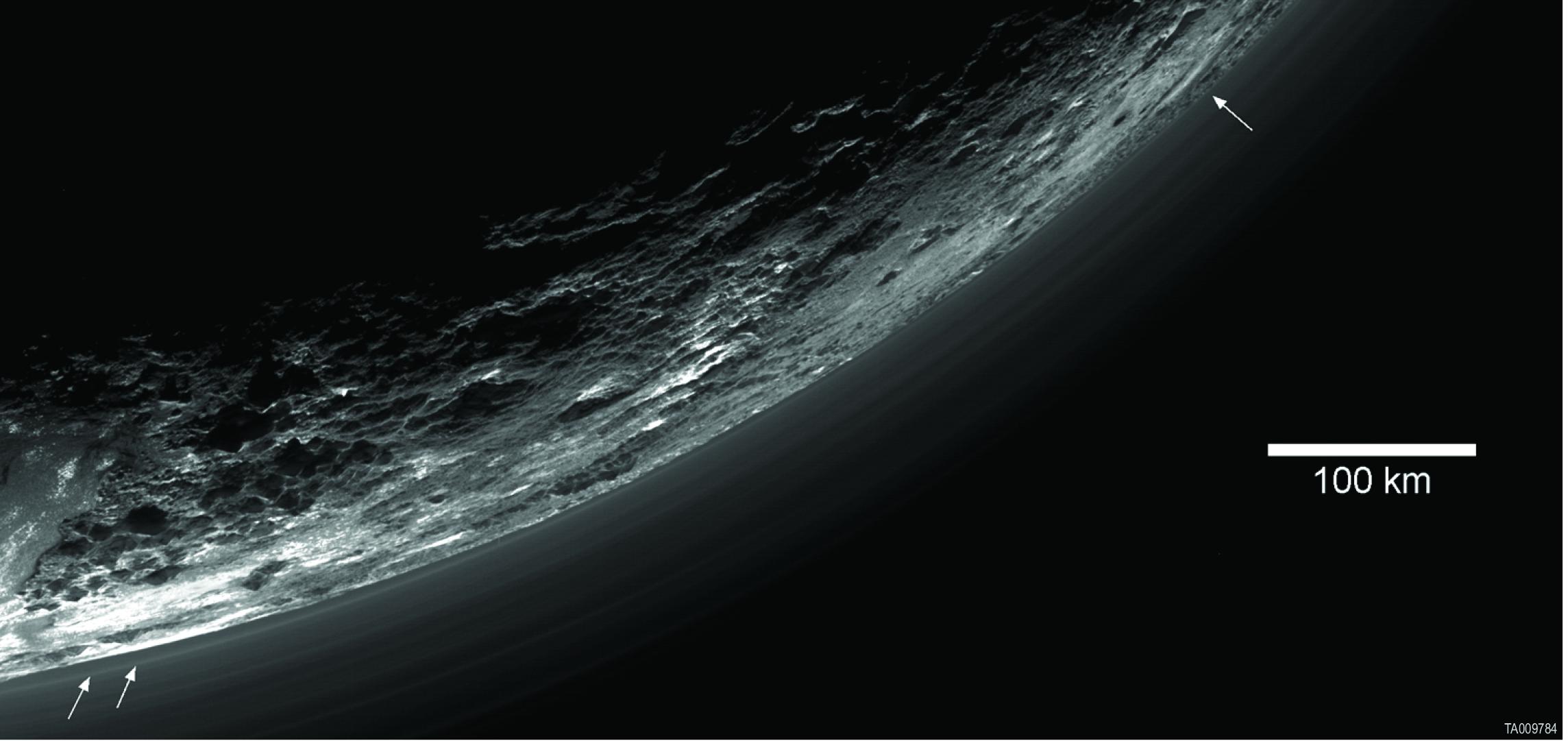
Pluto has no craters that were visible to New Horizons, indicating that its surface is less than 10 million years old and it has no magnetic field. It has a distinctive hazy blue atmosphere composed of nitrogen, methane and carbon monoxide. Methane is a powerful greenhouse gas and its presence creates a temperature inversion, which means that the average temperature of its atmosphere is tens of degrees warmer than its surface, though New Horizons told us that Pluto’s upper atmosphere is far colder than expected (70 Kelvin, as opposed to about 100 Kelvin).
Scientists think that Pluto has a rocky core surrounded by a mantle of water ice, which means it might have a sub-surface ocean at the boundary between the core and the mantle. Scientists also think that Sputnik Planitia was formed due to another object hitting the surface and in September 2016, they simulated this impact, showing that the formation of Sputnik Planitia might have been the result of liquid water upwelling from below after the collision. This implies the existence of a subsurface ocean at least 100 km deep.

Also in September 2016, astronomers announced that the reddish-brown cap of the north pole of the moon Charon is composed of organic macromolecules that may be the ingredients for life, produced from methane, nitrogen and other gases released from Pluto’s atmosphere and transferred 19,000 km to the orbiting moon.
And finally have you ever wondered how Pluto Got its Heart? According to a study published in April 2024 it happened due to a giant and slow oblique-angle impact on the Dwarf Planet.

Here is a video of Pluto
What a cool dwarf planet is Pluto! I have my fingers crossed that we can send an orbiter or maybe even a lander and find out more about this icy object far out in the solar system.
This article was first published in April 2021
All images Creative Commons and Public Domain and NASA/JPL-Caltech/Johns Hopkins University Applied Physics Laboratory/Southwest Research Institute/Alex Parker/ Tomruen.
Please subscribe to the You Tube Channel for more on science, history and nature and please do check out the website and follow on social media: Twitter // Instagram // Facebook // Reddit // Threads. You can check out the audio podcast on: Apple Podcasts // Stitcher // TuneIn // Spotify

Title music: Hovering Thoughts by Spence (YouTube Music Archive)
All Images: https://science.nasa.gov/gallery/pluto/