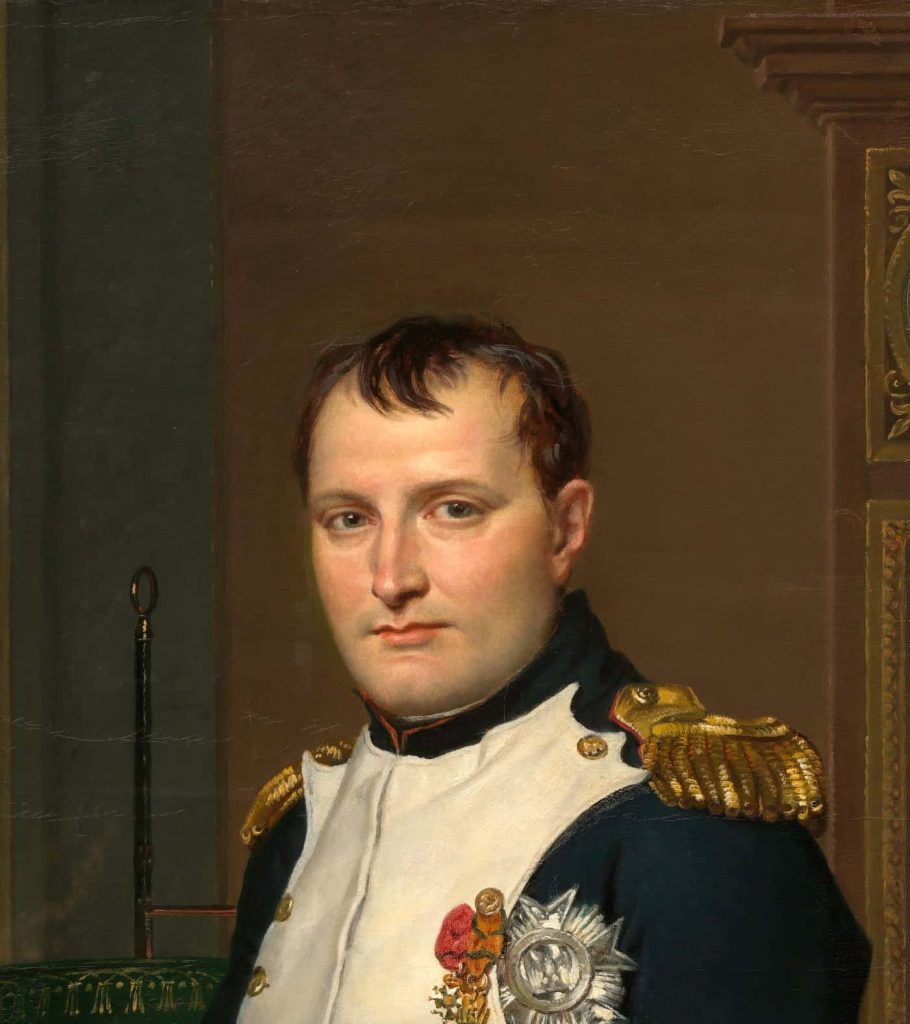
On May 18, 1804, a young man declared himself the Emperor of France. His campaigns split the European continent and reduced in half a country we hardly remember: Prussia. His name was Napoleon Bonaparte.
Born Napoleon Buonaparte in the French island of Corsica in 1769, he later changed his name to Napoleon Bonaparte and then just to Napoleon. A voracious reader of military history, he attended military school in France, graduating at the age of 16, when he became a second lieutenant in the French artillery.
The French revolution (1789 – 1799) had led to a shortage of military officers because most of them were aristocrats and had fled France, especially during the Terrors. This gave the opportunity to young officers to rise up in the ranks based on merits and Napoleon was one of them. He became brigadier general in 1793 at the age of 24 years due to his role in curtailing the rebellion in the city of Toulon. He became the commander of the Army of Italy after stopping a revolt in Paris in 1795.
The rest of Europe, including Great Britain kept a concerned eye on France during the French revolution, not interfering initially. Eventually, the Hapsburgs in Austria and the Prussian Empire became more concerned and from 1792 France found itself embroiled in wars with most European nations.
The “Little Corporal” as Napoleon came to be known, played a crucial role as the commander of the Army of Italy and led his troops into battle with Austria. His victories gave France control over Belgium and Lombardy and he became a national hero. One of his ambitions was to invade Great Britain, whom he called a “nation of shopkeepers”. Unable to do so he invaded Egypt instead, to hinder Britain’s North African and Indian trade lines.
He suffered a defeat at the hands of British admiral Horatio Nelson in 1798 and returned to Paris, where after a successful coup he became France’s First Consul – effectively its only ruler. He rewrote the French Constitution in 1804 to declare himself the Emperor of France.
A megalomaniac with charisma and a revolutionary with courage, he also brought many freedoms to Europe, especially to France. Throughout his European territories, he instituted the Napoleonic Code that guaranteed freedom of religion, abolished serfdom and established free schools and universities for all citizens. He also established the Bank of France. Naopleon brought greater freedoms to his European territories than its people had ever had before.
His strict conscription system meant he had a powerful army, which enabled him to invade many territories. The rest of Europe, especially Great Britain continued to fight many wars with him, collectively known as the Napoleonic Wars. His campaigns between 1805 and 1807 against Austria and the Russians led to treaties that divided Europe in half and saw the beginning of the end of Prussia. His second defeat at the hands of Horatio Nelson at Trafalgar on October 21 1805, angered him and he instituted the Continental System, effectively to exclude British trade from the Continent.
Perhaps Napoleon’s most well-known battle was with his former allies the Russians, whom he invaded on June 24, 1812. He had amassed his troops in Poland in the spring to intimidate Russian Tsar Alexander I. The Russians were unable to defeat him so they fell back and adopted a scorched earth strategy. When Napoleon entered Moscow in September 1812, he found a burned and empty city. He waited for a month for the Russians to either capitulate or engage but they did not. Freezing winter weather and attacks by Cossacks and other Russian groups forced him to return to Paris. His army was now weak and his enemies were stronger. Although he conscripted new soldiers, by October 1813 the British commander Arthur Wellesley, Duke of Wellington, had crossed the Pyrenees and invaded France. Napoleon’s field marshals finally forced him to abdicate on April 11, 1814 in Fountainbleau.
His banishment to the island of Elba lasted for less than a year and on February 26, 1815 Napoleon had escaped to return to France, still a hero to many. He retook power for a period known as The Hundred Days (actually 111 days, March 20-July 8, 1815). He tried to raise a new army but Great Britain, Austria, Prussia and Russia again formed a coalition against him. Finally, Wellington’s army defeated him again near the village of Waterloo, Belgium on June 18, 1815. His second abdication led to another exile, this time to the island of St Helena in the South Atlantic. He died there on May 21, 1851 at the age of 51, probably due to stomach cancer. His remains were returned to France in 1940 and interred at Les Invalides in Paris.
Napoleon had married Josephine Beauharnais in 1795. Letters exchanged between the two of them show the immense passion they had for each other and he had her crowned Princess Josephine when he became emperor in 1804. However, he annulled the marriage because she was unable to produce an heir and married Marie Louise of Austria, who, incidentally, was a Hapsburg. He provided a generous settlement for Josephine however, and the two remained in close contact. He also made his older brother Joseph Bonaparte, the King of Spain in 1808.
(Check out The Hapsburgs, an influential empire of whom you have never heard)
Napoleon influenced politics, law and military tactics across Europe and even North Africa and the Middle East for almost a quarter of a century. The Kingdom of the Netherlands (Netherlands, Belgium and Luxembourg) originated in the aftermath of his campaigns, effectively to contain France. Later Belgium and Luxembourg became independent. On France’s eastern front 39 German speaking states created and banded togeger to establish Germany in 1815. This was to coordinate the economies of German speaking countries and to replace the Holy Roman Empire that had survived for a thousand years till then and which Napoleon had dissolved on August 6, 1806. Both of these events were part of the Congress of Vienna in 1815 to provide a long-term peace plan after the Napoleonic wars.
Have you heard of the Louisiana Purchase? This is when Napoleon sold the state of Louisiana (a French territory) and other French territories in North America to the nascent United States of America.
Do you know of the Rosetta Stone?
It is a stele, which unlocked the ancient Egyptian hieroglyphic language, largely forgotten by this time. One of Napoleon’s soldiers found it by happenstance during his campaigns against the Turks (who were the rulers of Egypt) and Great Britain. The Rosetta Stone is now housed at the British Museum.
Podcast: Play in new window | Download