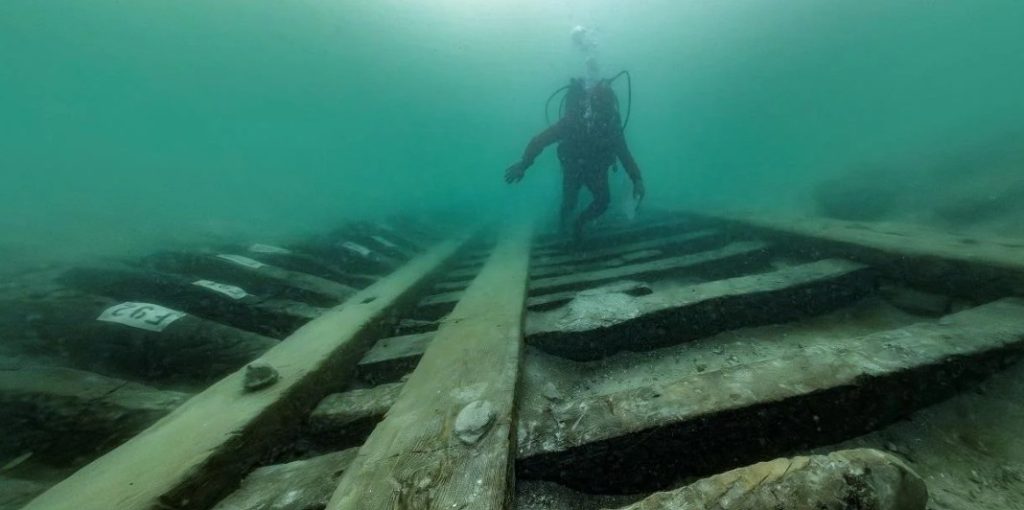
Archaeologists working in the submerged harbour of ancient Alexandria in Egypt have uncovered the remains of a rare luxury vessel long known from classical texts but never previously found: an Egyptian pleasure barge called a thalamagos. The discovery was made near the sunken island of Antirhodos, once part of Alexandria’s great Portus Magnus, during underwater excavations led by the European Institute for Underwater Archaeology (IEASM).

Well-preserved wooden timbers, approximately 28 meters in length, were found. Originally, the boat was about 35 meters long and about 7 meters wide. According to archaeologists, the vessel was powered solely by oars and required more than 20 rowers.
Greek graffiti on the ship’s central structure date it to the early first century CE and show it was built in Alexandria. This fits with Strabo’s earlier accounts of cabin-boats used for festivals, leisure, and religious ceremonies along the city’s lush canalways.

It was found less than 50 meters from the remains of the Temple of Isis, and both its location and dating indicates that the vessel might have sunk in a catastrophic event around CE 50, when earthquakes and tidal waves caused large parts of Alexandria’s shoreline, palaces, and temples to collapse into the sea. It may also have been a part of the Isis Sanctuary, playing a role in rituals such as the navigium Isidis, a ceremonial procession reenacting the goddess’s solar voyage toward Canopus.
The discovery is reminiscent of similar boats used by rulers, most notably by Cleopatra. Maybe she did travel in it on the way to see Mark Antony?
Image 1: Credit: Christoph Gerigk ©Franck Goddio/Hilti Foundation
Image 2: 3D view of the thalamagos, recorded through photogrammetry during IEASM excavations in Portus Magnus, Alexandria, Egypt, in late October 2025. The diver was 3D-captured in place on the shipwreck. Credit: 3D photogrammetry by Christoph Gerigk © Franck Goddio / Hilti Foundation
Image 3: Greek graffiti found on the central carling date to the first half of the 1st century CE. Credit: Christoph Gerigk © Franck Goddio / Hilti Foundation