Let’s meet the first ever woman to swim across the English Channel. Her name was Gertrude Caroline Ederle, born on October 23, 1905.
She was an American competition swimmer, as well as an Olympic champion, and world record-holder in five events. As if that wasn’t enough, she also became the first woman to swim across the English Chaneel on August 6, 1926. Before her, only five men had completed the swim across the English Channel. The best time of 16 hours, 33 minutes was acheived by Enrique Tirabocchi.
Gertrude grew up in Manhattan, the daughter of a butcher, and learned to swim in Highlands, New Jersey. She joined the Women’s Swimming Association at the age of 12 and continued to learn there. This is where she started her stellar career, becoming first world record in the 880-yard freestyle, the youngest world record holder in swimming. She subsequently set eight more world records, seven of which were in 1922 at Brighton Beach. From 1921 to 1925, Ederle held 29 US national and world records. It is no wonder that among other nicknames, the press sometimes also called her “Queen of the Waves”.
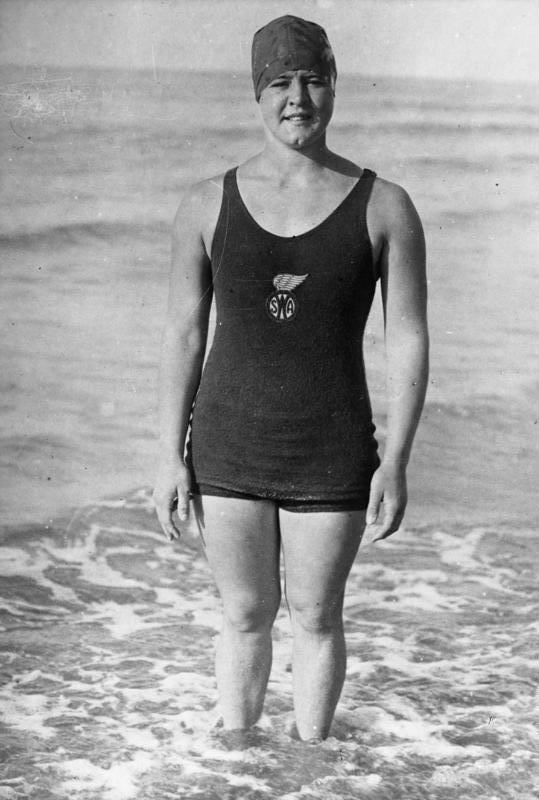
Ederle won a gold medal at the 1924 Summer Olympics in Paris, in which she participated as a member of the US team in the 4Á—100 meter freestyle relay. The whole team was placed first, and set a new world record of 4:58.8 in the event final. Individually, Gertrude received bronze medals in the women’s 100-meter freestyle and women’s 400-meter freestyle races. This highly aclaimed and succesful US Olympic team had its own ticker-tape parade in 1924!
After the olympics, Gertrude turned professional in 1925, swimming the 22 miles (35 km) from Battery Park to Sandy Hook in 7 hours and 11 minutes. This was another record and remained so for 81 years before being broken by Australian swimmer Tammy van Wisse. Her nephew Bob later described his aunt’s swim as a “midnight frolic” and a “warm-up” for her later swim across the English Channel.
Which was probably her crowning achievement, not least because no woman had done it before. No one thought that a woman would be able to make this difficult crossing. In fact, obstacles were put in her way to stop her from doing so.
She started in 1925, when the Women’s Swimming Association sponsored her and Helen Wainwright for an attempt at swimming across the English Channel. Ederle decided to go to France on her own, when Wainwright cancelled due to an injury. There, she trained with Jabez Wolffe, who had attempted the Channel crossing 22 times.
Gertrude made her first attempt at the English Channel swim on August 18, 1925 but was disqualified when her coach, Wolffe, had her recovered from the water. Ederle bitterly disagreed with his decision and there was rampant speculation that he had sabotaged her because he did not want her to succeed. She did not let this stand in her way however, and returned to New York to train with Bill Burgess, another successful Channel swimmer. By this time, she had received contracts from both the New York Daily News and Chicago Tribune, which provided her with a salary and paid her expenses.
Gertrude was now even more determined to swim across the English Channel and approximately one year after her first attempt, she was successful. Starting at Cap Gris-Nez in France at 07:08 am on August 6, 1926, this intrepid woman came ashore at Kingsdown, Kent, 14 hours and 34 minutes later, where she was met by a British immigration officer requesting a passport from “the bleary-eyed, waterlogged teenager”.
She had beaten the previous record of 16 hours 33 minutes – a record set by a man. Gertrude’s record stood until Florence Chadwick swam the Channel in 1950 in 13 hours and 23 minutes. When Ederle returned home, this time she was greeted with her own ticker-tape parade in Manhattan, with more than two million people thronging the parade route.
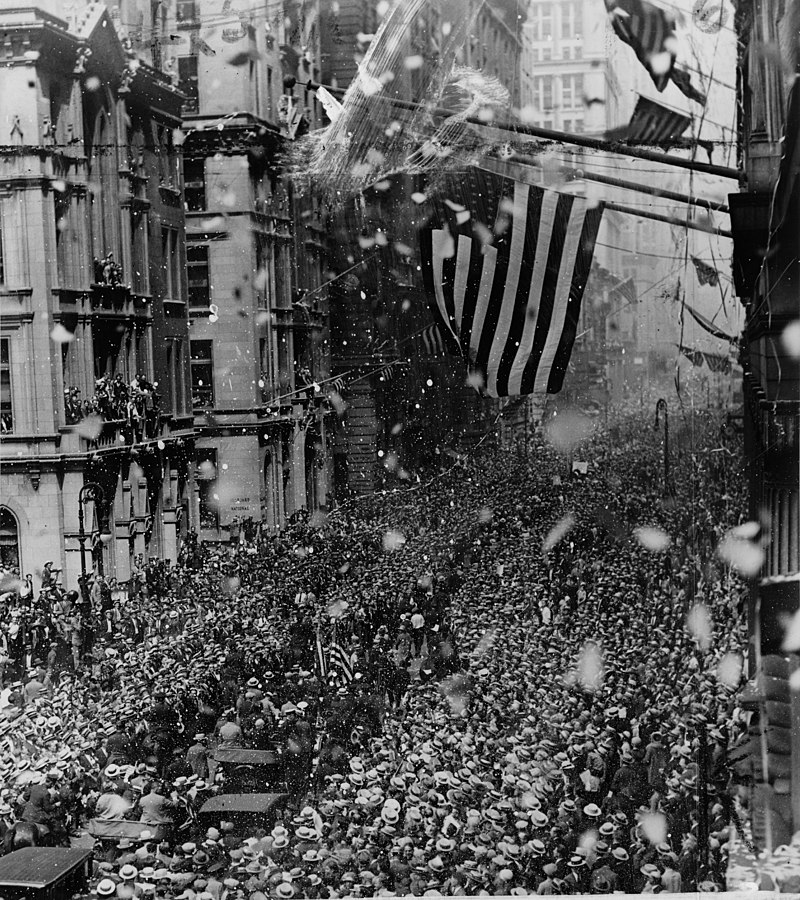

Gertrude Ederle would later perform in theater, tour the vaudeville circuit and even act in a movie, playing herself in Swim Girl, Swim. She met President Coolidge and had a song and a dance step named for her.
Tragically, she fell down the steps of her apartment building in 1933, which twisted her spine and left her bedridden for several years. She eventually recovered enough to appear in the 1939 New York World’s Fair.
Ederle experienced poor hearing from childhood due to a bout of measles and was nearly completely deaf by the 1940s. Beyond her vaudeville career, she dedicated time to teaching swimming to deaf children. Ederle never married and, by 2001 lived in a nursing home. She passed away on November 30, 2003, in Wyckoff, New Jersey, at the age of 98 and was laid to rest in Woodlawn Cemetery in the Bronx, New York City.

Gertrude Ederle was inducted into the International Swimming Hall of Fame, as an “Honor Swimmer” in 1965, and then was inducted into the National Women’s Hall of Fame in 2003. An annual swim from New York City’s Battery Park to Sandy Hook, New Jersey, is called the Ederle Swim in her memory and follows the course she swam.

Perhaps today we might not think much about women swimming across the Channel. But when Gertrude did this, it was not an easy task. Not for a woman. Women were considered physically and mentally weak and she would have had to bend over backwards to even be allowed to undertake this feat. And let’s not forget the speculations that her attempt was being sabotaged as well. I have no doubt that Gertrude Ederle not only put her life and limb at risk by swimming the English Channel, she also must have faced interminable difficulties in even attempting to do so.
She said: “People said women couldn’t swim the Channel, but I proved they could.”
She did not just break this glass ceiling, she shattered it completely, which makes her a fantastic woman indeed!.