Let’s talk about the largest planet in our solar system: Jupiter. We have already discussed Saturn so please do check out How Cassini made the Earth Smile to learn about Saturn, its, rings and moons.
The Name
Although it is named after the Roman God of sky and thunder, and king of the Gods, ancient civilisations long before the Romans knew of Jupiter, even before recorded history. It is one of the brightest objects in the sky and is visible to the naked eye, so it was easy to spot. In ancient Mesopotamia, the Babylonians, who had observed it in the seventh or eighth century BC, considered it to represent their god Marduke. They used geometric calculations to track Jupiter’s motion and then used its orbit to track the constellations in their zodiac. The Chinese, Koreans, Japanese and Vietnamese knew it as “wood star”, because they related it to one of the Chinese five elements and Hindu astrologers considered it the “teacher of gods”. We still invoke Jupiter every Thursday, which is named after the Germanic and Scandinavian god Thor. Thursday: Thor’s day, a counterpart of the Roman god. My point here is that Jupiter did not suddenly materialise into our consciousness because of Galileo. Many civilisations had observed it and tracked it.
The Discovery
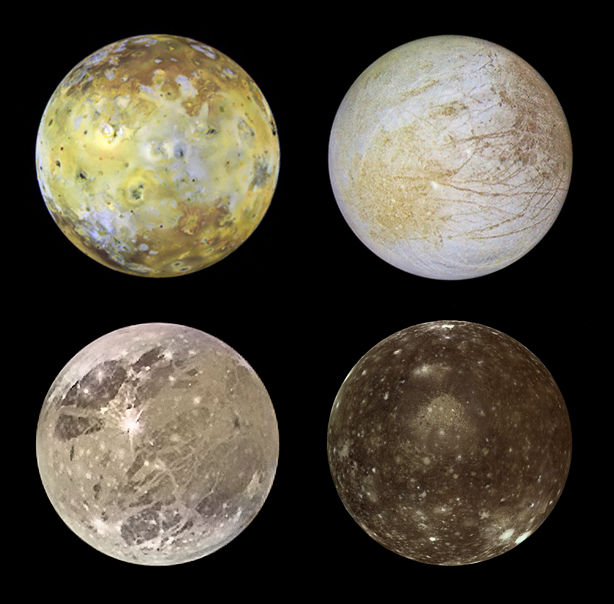
Then came the year 1609 and enter astronomer Galileo Galilei – the father of observational astronomy. He made detailed observations of the planet with his small telescope and then on January 7, 1610 he observed three points of light close to Jupiter. At first, he thought they were stars and then realised that they were orbiting Jupiter. These three and a fourth one he observed on January 13, are actually the four largest moons of Jupiter, now known as the Galilean moons. A German astronomer Simon Marius also observed them independently on January 8, 1610. While Simon Marius did not get sole credit for discovery of the moons, even though he had observed them before Galileo, the naming system he published in 1614 formed the basis of their names in the 20th century. Their names are Io, Europa, Ganymede and Callisto, each based on a lover of the god Jupiter or his Greek counterpart Zeus.
Galileo’s observations did something more though. They changed astronomy by supporting Copernicus’ theory that Earth was not the centre of the universe but that Earth and all the other planets revolved around the Sun, just as Jupiter’s moons orbited around it. This theory he expounded in his pamphlet The Sidereal Message (or The Sidereal Messenger) along with the description of Jupiter’s moons.
Missions
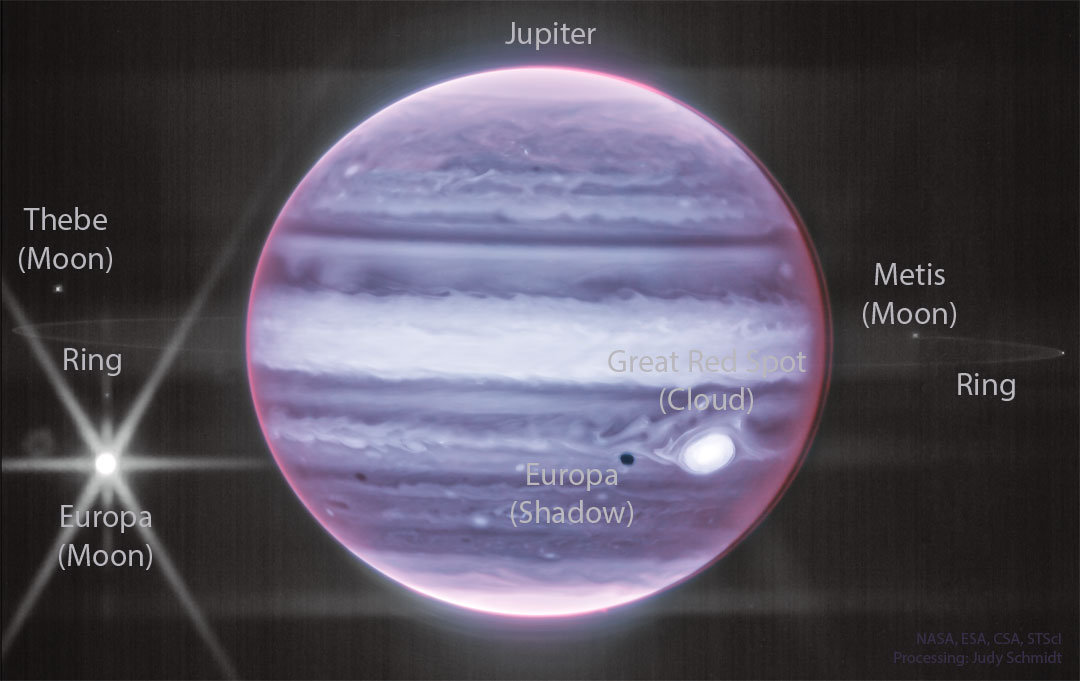
In 1973, Pioneer 10 became the first spacecraft to fly by Jupiter and to take close-up images, followed by Pioneer 11 in 1974. The Voyager mission flew by it in 1979 discovering that Jupiter also had rings and that its moon Io had volcanoes on its surface. Space probe Ulysses studied its magnetosphere in 1992 and then in the year 2000 Cassini stopped by on its way to Saturn, taking some of the highest resolution images of Jupiter along the way, as did the New Horizon spacecraft, which used Jupiter for gravity assist to push it along to Pluto in 2007.
(Read Voyagers 1 and 2, The Spacecraft That Keep on Giving)
The first spacecraft to actually orbit Jupiter was Galileo, starting on December 7, 1995 and it did so for seven years. It was close to Jupiter at the time when Comet Shoemaker-Levy 9 broke apart and collided with the planet in 1994 and was able to observe this phenomenon (see video above). Galileo also released a titanium atmospheric probe that entered Jupiter’s atmosphere, which collected data for almost an hour before the signal was lost. NASA crashed Galileo into Jupiter in 2003 to avoid possible contamination of the moon Europa, which is considered possibly suited to life. Altogether, nine spacecraft have visited and studied Jupiter and currently Juno orbits the gas giant, having entered into orbit in 2016.

The Fifth Planet
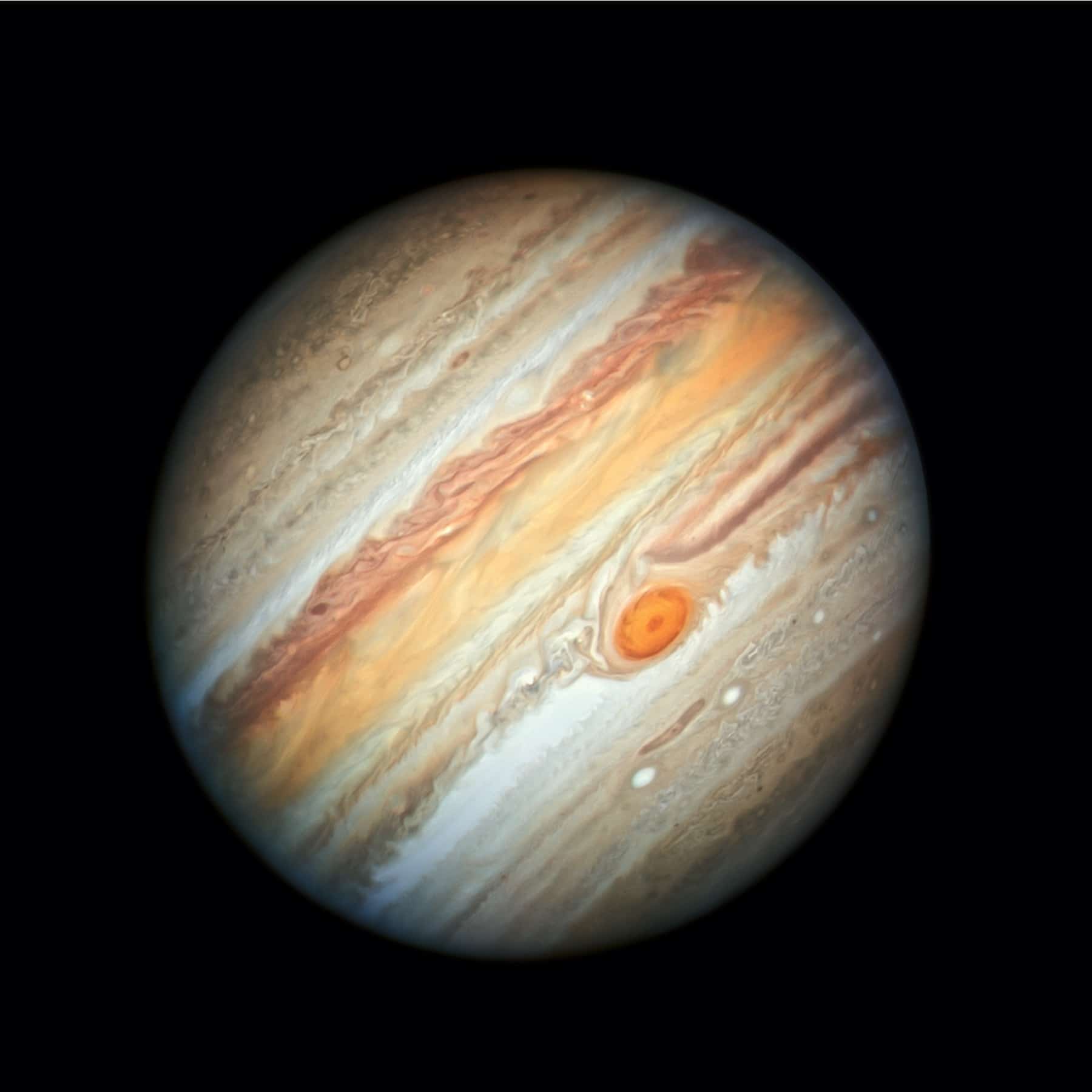
Jupiter is the fifth planet from the Sun, and of course, it’s the largest in the solar system. In fact, it is more than two times as large as all the other planets combined. With a radius of almost 70,000 km, it is 11 times wider than the Earth. It is 778 million km away from the Sun, so it takes sunlight 43 minutes to travel to it. For comparison, sunlight reaches Earth in eight minutes.

It takes Jupiter just 10 hours to rotate on its axis giving it the shortest day in the solar system but it takes 12 Earth years to orbit around the Sun. Earth’s orbit is tilted by an average of 23 degrees, which is the reason for our seasons. In comparison, Jupiter’s tilt is only 3 degrees and so its seasons are not as extreme ours’ or the other planets.
Known as a gas giant, it is composed of primarily hydrogen and helium (just like the Sun). Deep in its atmosphere, hydrogen is compressed into a liquid, with the result that Jupiter has the largest ocean in the solar system. But this ocean is made of hydrogen and is electrically conducting; scientists think that half way down into the atmosphere, the pressure is so great it squeezes off electrons from the hydrogen atoms. Jupiter has a very powerful magnetic field generated by its extremely fast rotation. We don’t know if it has a solid core, like the Earth, or if its core is composed of super-hot, dense liquid.
Our solar system started forming around 4.5 billion years ago and this is the time that Jupiter also started taking shape. Intense gravity pulled the gas and dust swirling around the Sun and compressed it into the gas giant. It took up most of the mass left over after the formation of the Sun. Being composed of hydrogen and helium means it has the same properties as a star but it did not ignite like a star because it was not massive enough. In its early days, Jupiter was situated closer to the Sun. Then it moved even closer along with the gas of the solar nebula, as it spiraled toward the Sun. Its position was that of where Mars is right now, but as Jupiter moved closer to the Sun, so did Saturn and the two became locked in orbital resonance. This is when astronomical bodies exert regular, periodical gravitational influence on each other because their orbital periods are relative. This orbital resonance caused the gas around the two giant planets to clear out and they migrated out to their present positions around four billion years ago. Because of this inward and outward migration – known as the Grand Tack Hypothesis – the planets in the inner solar system, like Mars, are small. Other systems have super Earth in this region and our solar system does not, also probably due to this migration. This might also explain the existence of the asteroid belt, containing both rocky and icy asteroids, between Mars and Jupiter (check out the video).
(Read Bringing Soil Samples Back from Asteroids)
Because it is a gas giant, Jupiter really doesn’t have a true surface. It is composed mainly of swirling gases and liquids, with extreme temperature and pressure, which would crush any spacecraft that ventured onto its surface. To us, its atmosphere appears as a beautiful painting of clouds and spots. It comprises of three distinct layers that span around 71 km. The top layer is made of ammonia ice, the middle is probably made of ammonium hydrosulphide crystals and the innermost layer is probably composed of water ice and vapour. The gorgeously vivid colours we see swirling around across the planet could be plumes of gases containing sulphur and phosphorus rising from the interior of the planet. The planet’s fast rotation also creates strong jet streams separating the clouds into bright and dark bands across its surface. Its stormy surface at the equator, has over a dozen different winds, some reaching 540 km/h.


The Great Red Spot
One of Jupiter’s most distinctive features is The Great Red Spot, a swirling anticyclonic storm twice the size of Earth, known to have existed since at least 1831 and possibly since 1665. Hubble Space Telescope images have identified two other red spots adjacent to it. Observations over the years have shown that the Great Red Spot seems to be decreasing in size. Storms like these are common in Jupiter’s turbulent atmosphere; it also has lesser storms known as white ovals and brown ovals. There is another giant vortex called the Great Cold Spot in the thermosphere in its north pole (more images in the video).
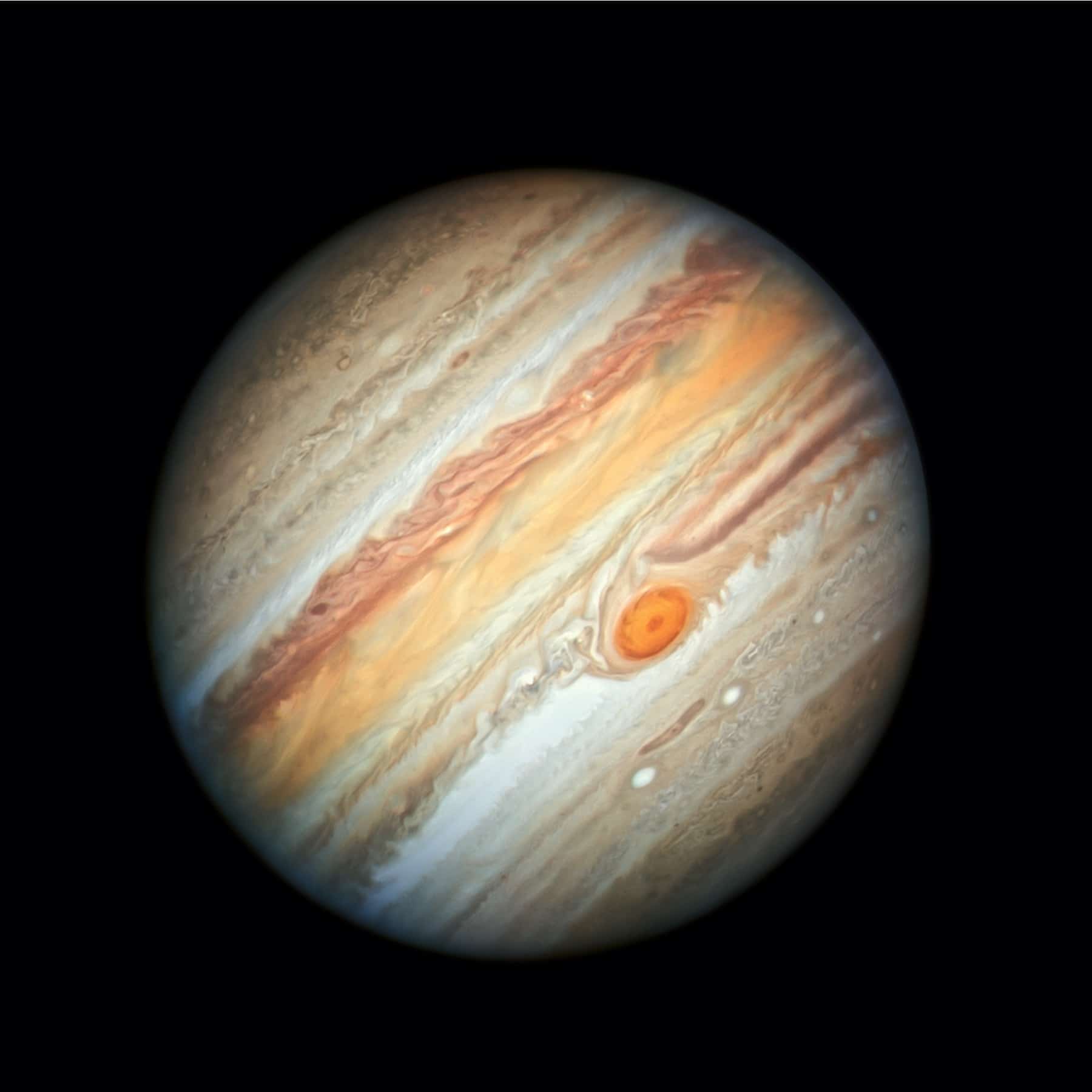

Jupiter’s magnetosphere is huge, extending from one to three million km into space, towards the Sun. It becomes a tapered tadpole like tail extending one billion kilometres behind the planet, going as far as Saturn’s orbit. Just like Earth, Jupiter’s magnetic field also creates auroras at its poles and these are some of the most spectacular sights in the solar system.


(Watch Are the Earth’s Magnetic Poles Flipping?)
The Moons
Altogether, Jupiter has a total of 79 moons, 53 confirmed and 26 provisional ones awaiting confirmation. The four largest are of course those described by Galileo and Simon Marius: Io, Europa, Ganymede and Callisto.
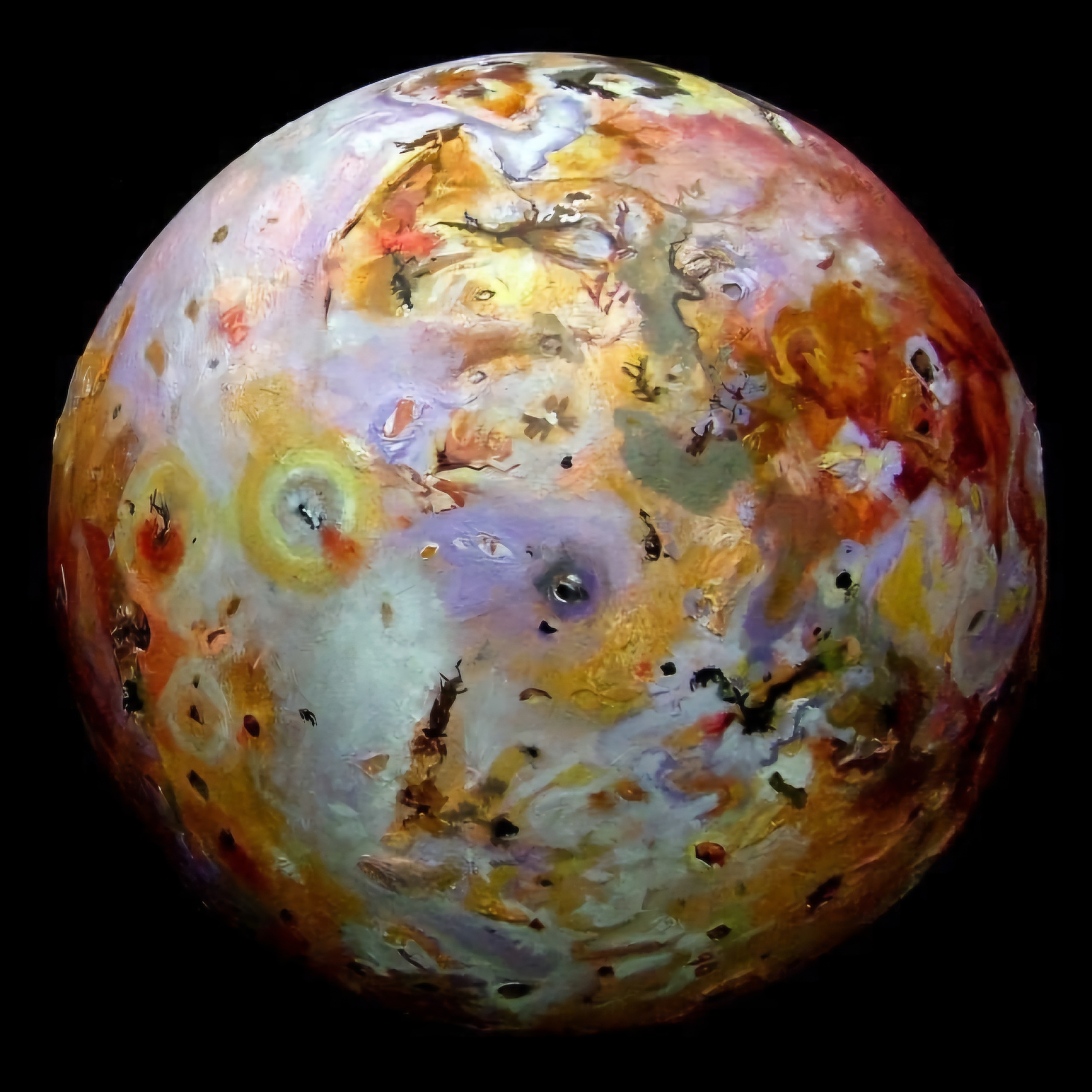
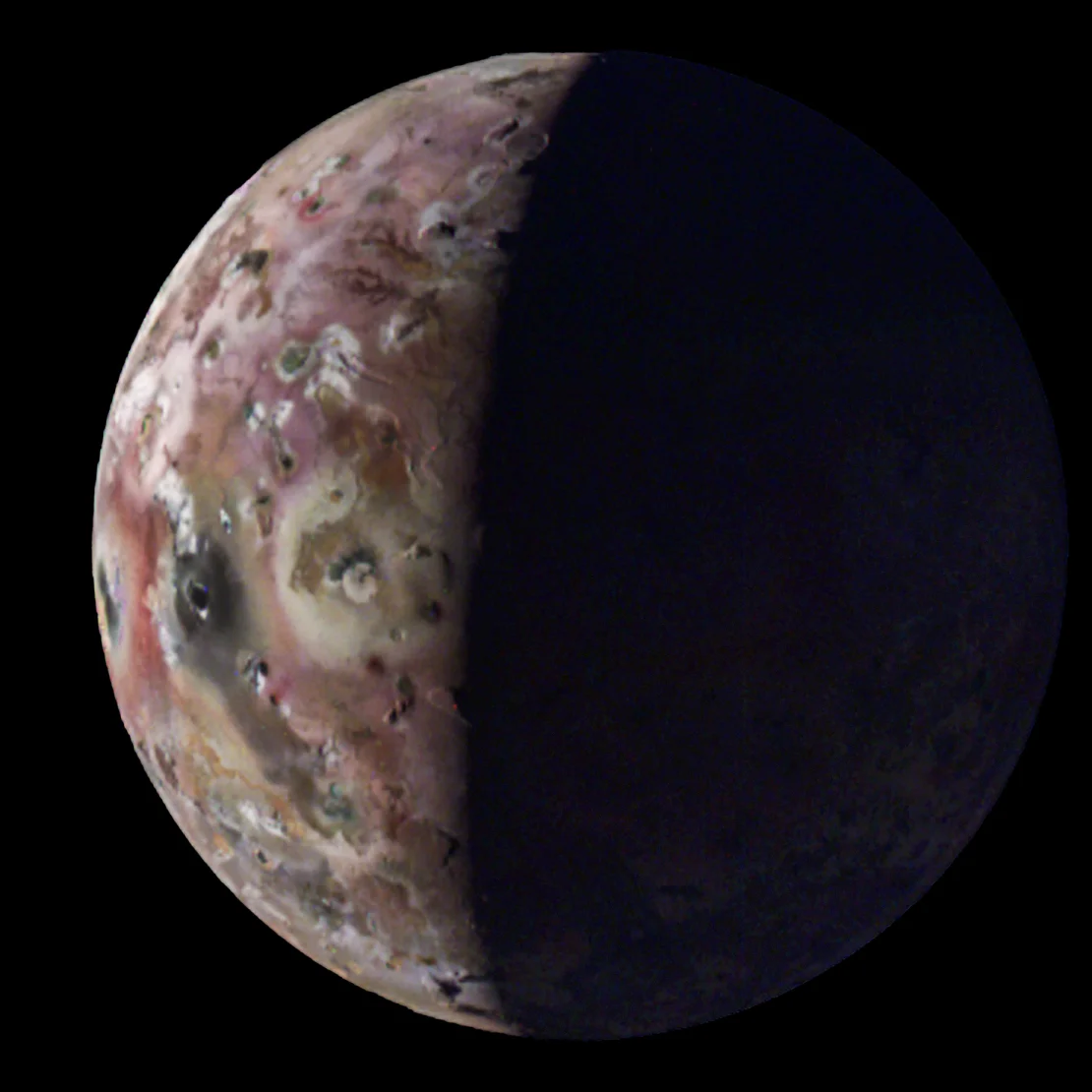
Io, Jupiter’s innermost moon, is the most volcanic body in the solar system with thousands of volcanoes, as well as being the fourth largest moon in the solar system. Its volcanoes are sometimes so huge we can see them through large telescopes from Earth. It is so geologically active because of tidal heating from friction generated within its interior, as it is pulled between Jupiter and the other Galilean moons. Io rotates on its axis and orbits Jupiter once every 1.8 Earth days, making it tidally locked, so the same side of Io always faces Jupiter. It has a very thin atmosphere of sulphur dioxide, the highest density of all solar system moons and the lowest amount of water of any other object in the solar system.

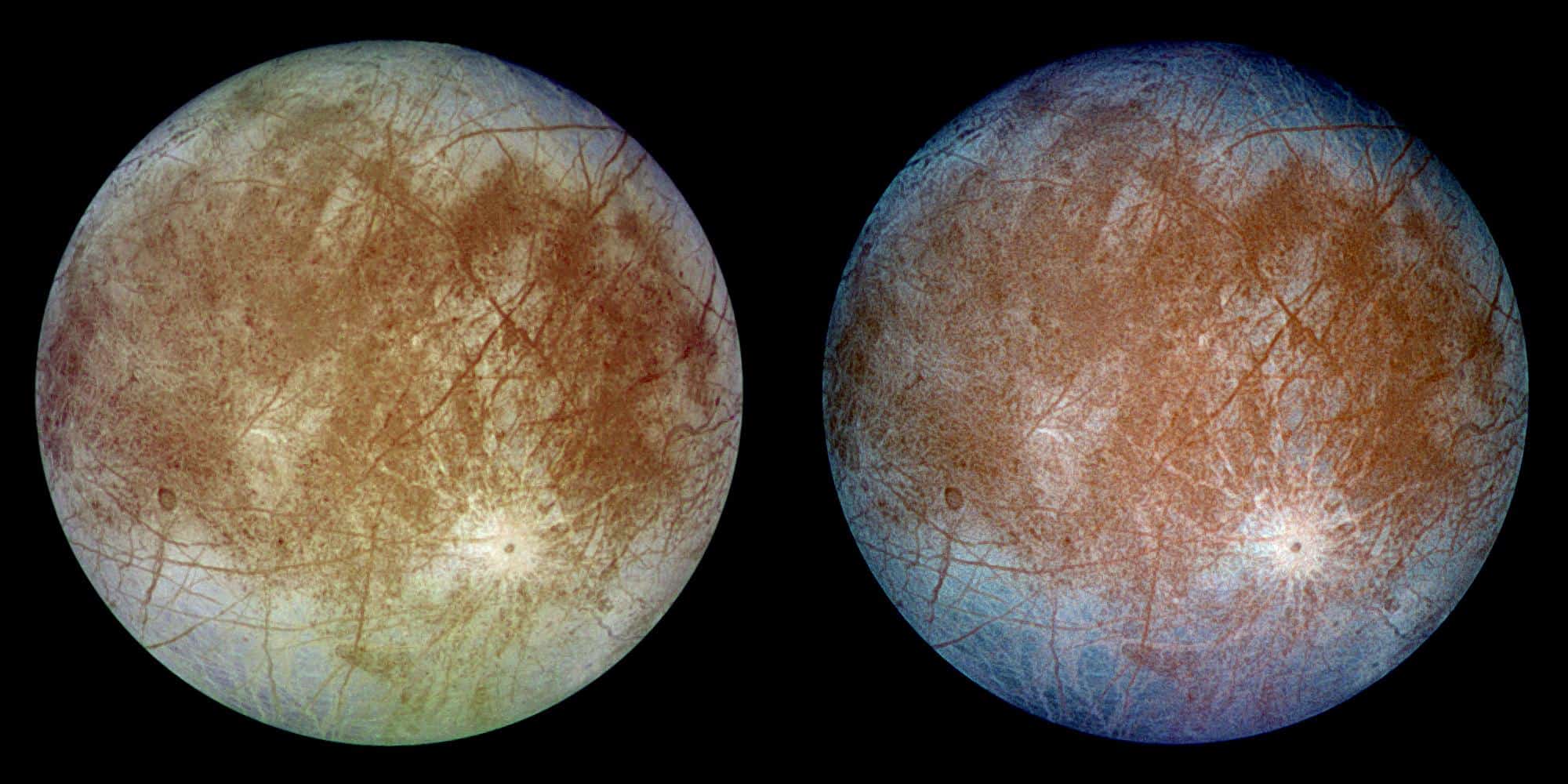
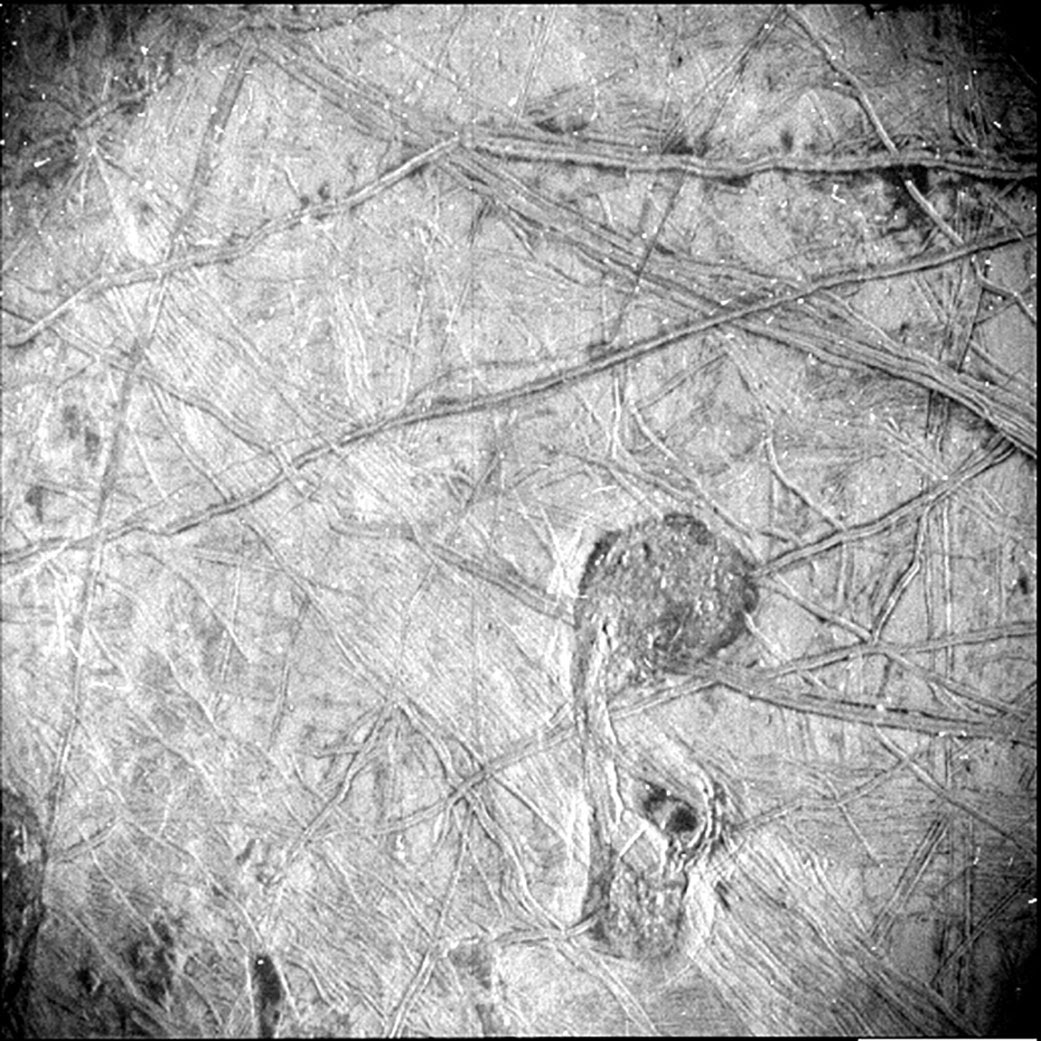
Europa is the smallest of the four Galilean satellites and the sixth largest in the solar system. It is made of silicate rock with a water-ice crust, and orbits Jupiter ever 3.5 Earth days. Scientists are almost certain that it has a salt-water ocean underneath the icy surface, which may contain twice as much water as Earth. Because of this, it is the most likely candidate to harbour some sort of life. Hubble Telescope data has suggested that thin plumes of water are ejected 160 km into space above Europa’s surface. In 2019, scientists announced that they had detected water vapour above its surface for the first time.
Ganymede is the largest moon in the solar system, eight percent larger than Mercury and the only moon with its own magnetic field generated by its iron core that also creates auroras. Above the iron core is the rocky mantle and then an 800 km shell of mostly ice. Ganymede orbits Jupiter every 7.15 Earth days and for every one of its orbits, Europa orbits twice and Io orbits four times (another example of orbital resonance).


Callisto is Jupiter’s second largest moon and the third largest in the solar system. Its surface is the most heavily cratered of any object in the solar system. The dark and bright white spots on its surface are probably areas with ice and those where ice has eroded. Callisto may also have a salty ocean deep under the surface. It rotates on its axis and orbits Jupiter every 17 days.

What next for this grandfather of all planets?
European Space Agency’s JUICE mission- JUpiter ICy moons Explorer launched from Europe’s Spaceport in Kourou, French Guiana, on an Ariane 5 launcher on 14 April 2023, with arrival at Jupiter in 2029. It will spend at least three years making detailed observations of the gas giant and three of its largest moons, Ganymede, Callisto and Europa.
NASA’s Europa Clipper spacecraft launched Oct. 14, 2024 and will conduct a detailed survey of Europa to determine whether the icy moon could harbour conditions suitable for life.
Of course, Juno launched in 2011, orbiting Jupiter since 2016 is still there. Now in its extended mission, Juno will continue its investigation of the solar system’s largest planet through September 2025, or until the spacecraft’s end of life. It got a gravity assist during its Earth flyby in 2013 and took some awesome images of our planet. Fingers crossed the upcoming missions will find some sort of life on Europa. Here are some Stunning New Images by JunoCam
This article was first published on 24 April 2020.
Music: Moonrise by Chad Crouch – Instrumental from Free Music Archive. All images NASA/ESA/JPL-Caltech/SwRI/MSSS and University of Arizona (Public Domain,Creative Commons). Details of processing credit available at Nasa.gov.
Featured Image: Jupiter by Hubble Space Telescope NASA, ESA, A. Simon (Goddard Space Flight Center) and M.H. Wong (University of California, Berkeley)
You can subscribe to the You Tube Channel for more on science, history and nature. Please do check out the website and follow on social media Twitter // Instagram // Facebook // Reddit // Threads and check out the audio podcast on Apple Podcasts // Stitcher // TuneIn // Spotify
Podcast: Play in new window | Download