Nestled in the heart of Morocco, Marrakesh is a city with vibrant colors, bustling souks, and rich cultural tapestry. This North African gem has long been a magnet for adventurers, artists, and seekers of exotic experiences. Let’s take a photographic stroll through the labyrinthine streets of Marrakesh, exploring its main attractions and immersing ourselves in its captivating culture.
1. Jemaa el-Fnaa Square: The Heartbeat of Marrakesh At the heart of the medina lies Jemaa el-Fnaa, a pulsating square that encapsulates the essence of Marrakesh. By day, it’s a marketplace teeming with snake charmers, storytellers, and local artisans, while by night, it transforms into a lively food haven with aromatic stalls serving traditional Moroccan delicacies. The square is a microcosm of the city’s energy and diversity.
Jemaa el Fnaa main square with cars and people. Image by 360onhistory.comJemaa el Fnaa in Marrakesh. Image: 3600nhistory.comJemma el Fnaa Square in Marrakesh. Image: 360onhistory.com.Jemaa el Fnaa side road. Image by 360onhistory.comStalls selling hats and other things at Jemaa El Fnaa, Marrakesh. Image by 360onhistory.comA man selling at Jemaa El Fnaa, Marrakesh. Image by 360onhistory.com
At night Jemaa El Fnaa completely transforms into a food hub with stalls selling local delicacies, street performers and bards telling stories. It is frequented by both locals and tourists. The name Jemaa El Fnaa translates to “assembly of the dead”, referring to public executions on the plaza around 1050 CE. The place is known for its active concentration of traditional activities by storytellers, musicians, and performers
The idea of the UNESCO project Masterpieces of the Oral and Intangible Heritage of Humanity came from people concerned about the Jamaa el Fna.
Horse carts at Jemaa El Fnaa, Marrakesh. Image by 360onhistory.comStory tellers getting ready to regale audiences with ancient Moroccan stories at Jemaa El Fnaa, Marrakesh. Image by 360onhistory.comTwo men sitting on chairs looking at the activity around Jemaa el Fnaa, Marrakesh. Image by 360onhistory.comStalls at Jemaa El Fnaa, Marrakesh. Image by 360onhistory.comA stall with vender sitting next to it selling Argan Oil, Jemaa El Fnaa, Marrakesh. Image by 360onhistory.comA man in very colourful clothes holding a case with watches at Jamaa El Fnaa, Marrakesh. Image by 360onhistory.comPeople bustling around stalls selling argan oil products at Jemaa el Fnaa at night. Image by 360onhistory.comPeople bustling around at Jemaa el Fnaa at night. Image by 360onhistory.comPeople bustling around at Jemaa el Fnaa at night. Image by 360onhistory.comA man in white chef’s coat and hat selling local delicacy, snail soup, at Jemaa el Fnaa, Marrakesh. Image by 360onhistory.comA food stall with chef selling food at Jemaa el Fnaa square in Marrakesh. Image by 360onhistory.com
2. Koutoubia Mosque: A Soaring Symbol Dominating the skyline with its elegant minaret, the Koutoubia Mosque is a symbol of Marrakesh. Dating back to the 12th century, this masterpiece of Almohad architecture stands as a testament to the city’s rich history. Visitors can admire the mosque’s intricate details and explore the surrounding gardens for a serene escape from the urban hustle.
This towering landmark in Marrakesh, boasts the title of the city’s largest mosque. Built in 1158 after an initial construction in 1147, it stands as a testament to Almohad architecture and Moroccan mosque design.
Its soaring minaret, reaching 77 meters (253 ft) into the sky, is adorned with intricate geometric arches and crowned with a gleaming spire and metal orbs. This iconic landmark likely inspired other structures like the Giralda of Seville and the Hassan Tower of Rabat.
The mosque’s name, “Koutoubia,” hints at its past. Derived from the Arabic word for “booksellers,” it reflects the bustling book trade once thriving in the nearby souk. While the vendors may be gone, the Koutoubia Mosque remains a majestic symbol of Marrakesh.
MInaret of Koutoubia Mosque from a distance at night. Image by 360onhistory.comTop of the minaret and front wall of Koutoubia Mosque, Marrakesh. Image by 360onhistory.comSide wall of Koutoubia Mosque with ornate islamic style porticos and doors. Image by 360onhistory.comA side wall to the Koutoubia Mosque to the left with a palm tree on the tiled path going around the walls. Image by 360onhistory.comSideview of the 12th century Koutoubia Mosque and its front yard with pillars, Marrakesh. Image by 360onhistory.comSideview of the 12th century Koutoubia Mosque and its front yard with pillars, Marrakesh. Image by 360onhistory.comSideview of the 12th century Koutoubia Mosque and its front yard with pillars, Marrakesh. Image by 360onhistory.comSide wall of Koutoubia Mosque, Marrakesh. Image by 360onhistory.comThe 12th century Koutoubia Mosque and its front yard with pillars, Marrakesh. Image by 360onhistory.comKoubba of Lalla Zohra near Koutoubia Mosque, Marrakesh. Image by 360onhistory.comMinaret of the 12th century Koutoubia Mosque, Marrakesh. Image 360onhistory.com
3. The Ben Youssef Madrasais an Islamic madrasa (college) in Marrakesh, Morocco. Functioning today as a historical site, the Ben Youssef Madrasa was the largest Islamic college in the Maghreb at its height. The madrasa is named after the adjacent Ben Youssef Mosque built by the Almoravid Sultan Ali ibn Yusuf in the early 12th century, and was commissioned by the Saadian Sultan Abdallah al-Ghalib in the 16th century.
Image looks up towards a skylight with various square balconies rising up at the Ben Youssef Madrasa, Marrakesh. Image by 360onhistory.comA khateeb (scribe) sitting at a table and doing calligraphy. Image by 360An ornate wooden door with beautifully carved surrounding walls which have colourful Islamic tiles at the lower half at Ben Youssef Madrasa, Marrakesh. Image by 360onhistory.comA central courtyard (riad) at Ben Youssef Madrasa, Marrakesh. Image by 360onhistory.comA square pool with water in the central courtyard (riad) at Ben Youssef Madrasa, Marrakesh. Image by 360onhistoryA gorgeously carved wooden wall with door at Ben Youssef Madrasa, Narrakesh. Image by 360onhistory.comAblution Basin at Ben Youssef Madrasa, Marrakesh. It was brought back from Andalusia by Almoravid Sovereign Youssef Ben Tachfine. Image by 360onhistory.comCeiling of Ben Youssef Madrasah with chandelier. Image by 360onhistory.comA central courtyard (riad) at Ben Youssef Madrasa, Marrakesh. Image by 360onhistory.comAn ornate wooden door with beautifully carved surrounding walls which have colourful Islamic tiles at the lower half at Ben Youssef Madrasa, Marrakesh. Image by 360onhistory.comOrnately carved wooden wall with a window. Image by 360onhistoryA gorgeously carved wooden wall with door at Ben Youssef Madrasa, Narrakesh. Image by 360onhistory.comA carved wooded door and alcove with carvings at the top section and coloured mosaic at the lower third. Image by 360onhistory.comDoor at Ben Youssef Madrasa, Marrakesh. Image by 360onhistory.comWooden balcony at first floor of Ben Youssef Madrasa. Image by 360onhistory.comWooden balcony and doors at first floor of Ben Youssef Madrasa. Image by 360onhistory.comView of the central courtyard (riad) from a first floor window of Ben Youssef Madrasa. Image by 360onhistory.com
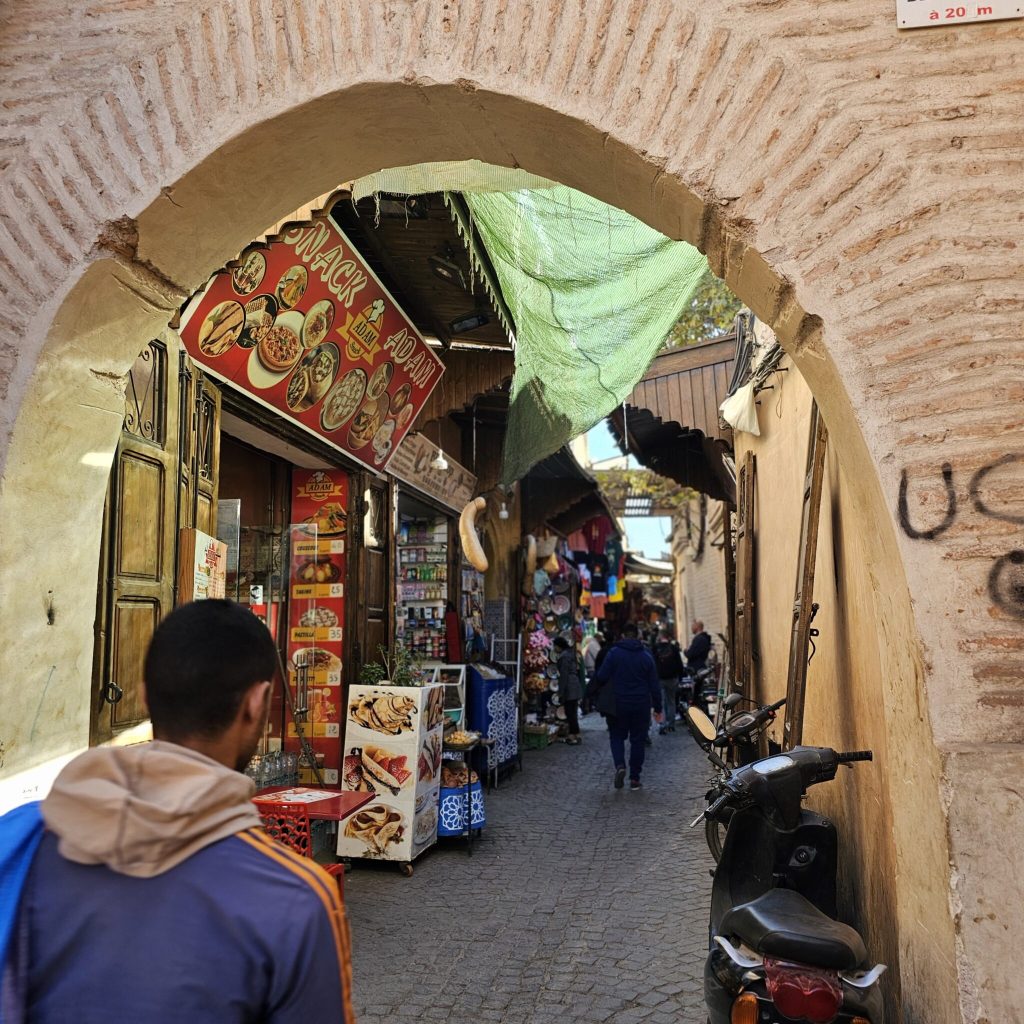
4. Souks and Medina: Shopping Extravaganza No visit to Marrakesh is complete without a foray into its bustling souks and medina. Lose yourself in the narrow alleys filled with aromatic spices, intricately woven textiles, and handcrafted ceramics. From the vibrant hues of the dyers’ souk to the aromatic scents of the spice market, each corner offers a sensory journey through Morocco’s rich artisanal heritage
A stall selling colourful Moroccan plates and dishes in a souk in Jemaa El Fnaa, Marrakesh. Image by 360onhistory.comA small side street, one of many in Jemaa El Fnaa, Marrakesh. Image by 360onhistory.comA stall selling Moroccan leather bags and shoes in a souk in Jemaa El Fnaa, Marrakesh. Image by 360onhistory.comA small side street, through an archway, one of many in Jemaa El Fnaa, Marrakesh. Image by 360onhistory.comA small side street, one of many in Jemaa El Fnaa, Marrakesh. Image by 360onhistory.comA small side street, one of many in Jemaa El Fnaa, Marrakesh. Image by 360onhistory.comA small side street, one of many in Jemaa El Fnaa, Marrakesh. Image by 360onhistory.comA small side street, one of many in Jemaa El Fnaa, Marrakesh. Image by 360onhistory.com
5. The Saadian Tombs: Hidden Treasures Tucked away in the heart of the Kasbah, the Saadian Tombs are a historical marvel discovered in 1917. Dating back to the 16th century, these tombs house the remains of members of the Saadian dynasty. Intricately decorated with stunning tilework and carvings, the tombs provide a fascinating glimpse into Morocco’s royal past.
Graves inside Saadian Tombs, Marrakesh. Image by 360onhistory.comGraves inside Saadian Tombs, Marrakesh. This chamber is known as the room of 12 pillars. Image by 360onhistory.comGraves inside Saadian Tombs, Marrakesh. This is the room of three niches. Image by 360onhistory.com
6.Bahia Palace: This glorious palace is a mid to late 19th-century palace in Marrakesh. It is a mid to late 19th-century palace first begun by Si Musa, grand vizier of Alaouite sultan Muhammad ibn Abd al-Rahman, in 1859 and then continued and expanded by his son Si Ba Ahmed ibn Musa, grand vizier of Sultan Moulay Abdelaziz between 1894 and 1900. Today, it is a well-known historic monument and tourist attraction in the city. Si Musa was descended from a family of black slaves, which served the Moroccan royal government and reached the highest offices in the country. He was first hajib (similar to a chamberlain) then grand vizier under Muhammad ibn Abd al-Rahman, who reigned from 1859 to 1873.
A corridor with circular columns that goes around the central courtyard of Bahia Palace, Marrakesh. Iamge by 360onhistory.comThe central courtyard (riad) at Bahia Palace, Marrakesh, with people milling around. Image by 360onhistory.comA smaller courtyard at Bahia Palace, with people milling around. Image by 360onhistory.comA giant fireplace at Bahia Palace with colourful tiles and mosaic around it. Image by 360onhistory.comA scribe sits on the floor in front of a doorway at Bahia Palace, Marrakesh. He has books and papers in front of him. Image by 360onhistory.comA beautifully designed and colourful ceiling at Bahia Palace, Marrakesh. A fine example of Islamic decor. Image by 360onhistory.comA corridor at Bahia Palace, Marrakesh. The floor is colourfully tiled. Image by 360onhistory.comA beautifully designed and colourful ceiling at Bahia Palace, Marrakesh. A fine example of Islamic decor. Image by 360onhistory.comGiant wooden carved doors at Bahia Palace, Marrakesh. Image by 360onhistory.Giant wooden carved doors at Bahia Palace, Marrakesh. Image by 360onhistory.Courtyard of Bahia Palace. Image by 360onhistory
Cultural Aspects and the Atlas Mountains: A Tapestry of Traditions Marrakesh is a melting pot of cultures, blending Arab, Berber, and French influences. The city’s architecture, cuisine, and traditions reflect this rich tapestry, creating a unique and immersive experience for visitors. Whether sipping mint tea in a traditional riad or witnessing a mesmerizing display of belly dancing, Marrakesh invites you to embrace its diverse cultural heritage.
Finally, the Atlas Mountaibs are breathtaking and full of biodiversity.
Traditional water seller or “Gharrib,” in Jemaa El Fnaa, Marrakesh. He is wearing bright red clothes and hat and has brass water utensils hung around him. Image by 360onhistory.comWomen pressing argan seeds to extract argan oil. Ourika Valley, near Marrakesh. Image by 360onhistory.comA view of Atlas Mountains in Ourika Valley, near Marrakesh. Image by 360onhistory.comDyed cactus flowers from prickly pear cacti, in many colours on the street of Jemaa El Fnaa, Marrakesh. These are used as infusion in tea. Image by 360onhistory.com
Marrakesh certainly is a city that captivates the senses, offering a kaleidoscope of colors, flavors, and traditions. With its historic landmarks, vibrant markets, and welcoming atmosphere, Marrakesh stands as a testament to Morocco’s enduring allure. Explore its winding streets, engage with its warm-hearted locals, and let Marrakesh weave its enchanting spell on you.