Brown dwarfs, occasionally referred to as unsuccessful stars, undergo gravitational collapse similar to stars but lack the necessary mass to initiate nuclear fusion. Some of the smallest brown dwarfs share a mass range with giant planets. Astronomers utilizing the NASA/ESA/CSA James Webb Space Telescope have recently identified a new record-breaking brown dwarf, weighing merely three to four times the mass of Jupiter, in their pursuit of discovering the tiniest brown dwarfs.
Brown dwarfs are very cool! They occupy a unique position on the celestial spectrum, existing between stars and planets. These cosmic objects undergo a stellar-like formation process, becoming dense enough to succumb to gravitational collapse. However, unlike stars, they never attain the necessary density and heat to initiate hydrogen fusion and evolve into full-fledged stars. Some brown dwarfs, particularly at the lower end of the mass scale, share similarities with giant planets, their masses only a few times that of Jupiter.
(Read more: Brown Dwarfs – Planets, stars, or something entirely different?)
To understand the minimal size for objects to form in a star-like fashion, a collaborative international effort utilizing the NASA/ESA/CSA James Webb Space Telescope has pinpointed a groundbreaking discovery. They have identified a tiny, free-floating brown dwarf, setting a new record with a mass ranging from three to four times that of Jupiter.
“One basic question you’ll find in every astronomy textbook is, what are the smallest stars? That’s what we’re trying to answer,” explained lead author Kevin Luhman of Pennsylvania State University.
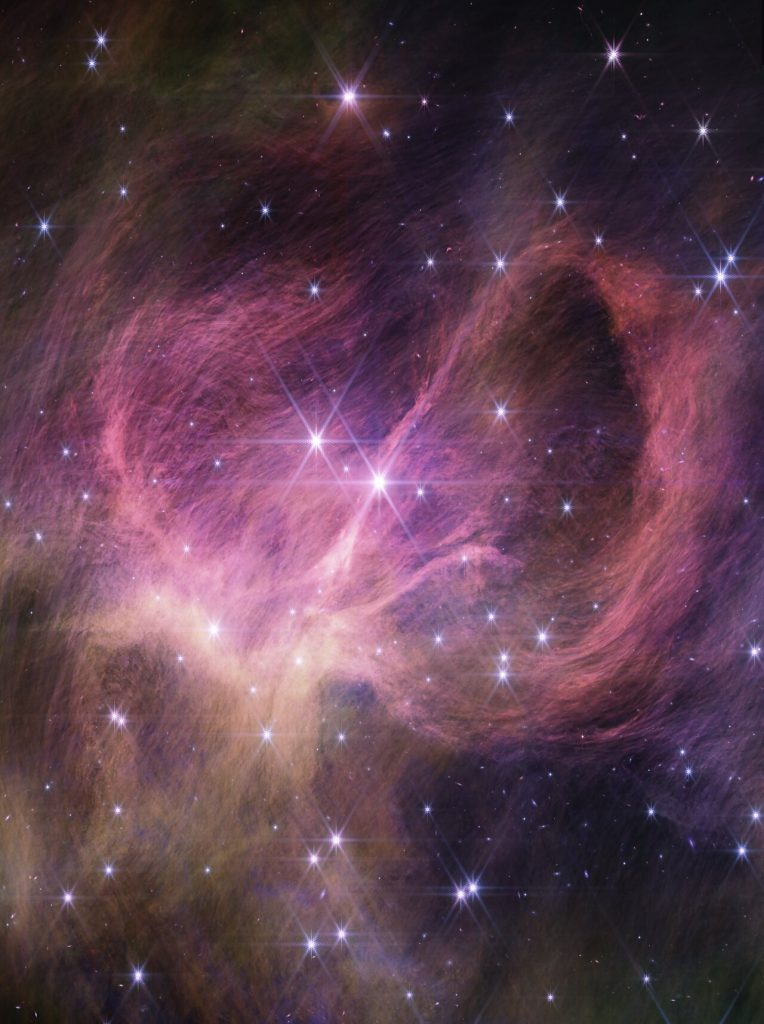
To pinpoint the recently discovered brown dwarf, Luhman and colleague Catarina Alves de Oliveira focused on the star cluster IC 348, situated 1000 light-years away in the Perseus star-forming region. This cluster, aged around five million years, still hosts relatively bright brown dwarfs in infrared light due to their recent formation.
Initially, the team used Webb’s NIRCam to image the cluster’s center, identifying brown dwarf candidates based on brightness and colors. Subsequently, Webb’s NIRSpec microshutter array was employed to investigate the most promising targets. The team benefited from Webb’s infrared sensitivity, detecting fainter objects compared to ground-based telescopes, and its precise vision distinguished between pinpoint brown dwarfs and amorphous background galaxies.
This screening process revealed three intriguing targets, with masses ranging from three to eight times that of Jupiter and surface temperatures spanning 830 to 1500 degrees Celsius. The smallest among them, with a mass of three to four times that of Jupiter, poses a theoretical challenge for formation due to its smaller size and weaker gravity compared to typical star-forming clouds.

“It’s pretty easy for current models to make giant planets in a disc around a star,” said Catarina Alves de Oliveira of ESA, principal investigator on the observing programme. “But in this cluster, it would be unlikely that this object formed in a disc, instead forming like a star, and three Jupiter masses is 300 times smaller than our Sun. So we have to ask, how does the star formation process operate at such very, very small masses?”
According to ESA: “In addition to providing clues about the star formation process, tiny brown dwarfs also can help astronomers better understand exoplanets. The least massive brown dwarfs overlap with the largest exoplanets; therefore, they would be expected to have some similar properties. However, a free-floating brown dwarf is easier to study than a giant exoplanet since the latter is hidden within the glare of its host star.
Two of the brown dwarfs identified in this survey show the spectral signature of an unidentified hydrocarbon, a molecule containing both hydrogen and carbon atoms. The same infrared signature was detected by NASA’s Cassini mission in the atmospheres of Saturn and its moon Titan. It has also been seen in the interstellar medium, the gas between stars.”
“This is the first time we’ve detected this molecule in the atmosphere of an object outside our Solar System,” explained Alves de Oliveira. “Models for brown dwarf atmospheres don’t predict its existence. We’re looking at objects with younger ages and lower masses than we ever have before, and we’re seeing something new and unexpected.”
Given that the entities fall within the mass spectrum of giant planets, a crucial question arises: are they brown dwarfs or, alternatively, rogue planets expelled from planetary systems? While the team cannot definitively dismiss the latter possibility, they contend that the more plausible scenario is that these entities are brown dwarfs rather than ejected planets.
The likelihood of ejected giant planets is diminished for two key reasons. Firstly, such planets are generally uncommon compared to those with lesser masses. Secondly, low-mass stars predominate among stars, and giant planets are particularly rare in such stellar systems. Consequently, it seems improbable that the majority of stars in IC 348 (mostly low-mass stars) could give rise to these massive planets. Furthermore, considering the cluster’s youth of merely five million years, there appears to be insufficient time for giant planets to develop and subsequently be expelled from their systems.
To gain more clarity regarding their classification, the discovery of additional similar objects is crucial. The prevailing theories propose that rogue planets are more likely to be situated on the outskirts of a star cluster. Therefore, broadening the search area within IC 348 may unveil more instances if they indeed exist.
Future investigations might also involve more extensive surveys capable of detecting fainter and smaller objects. The team’s brief survey was designed to identify entities as small as twice the mass of Jupiter, whereas more protracted surveys could easily extend the detection limit to one Jupiter mass.
These observations were taken as part of Guaranteed Time Observation program #1229. The results were published in the Astronomical Journal.