Neptune, the icy-giant in our Solar System is a wonderful blue world with supersonic winds, fourteen moons and even sporting wispy rings.
The Solar System of which our planet- Earth- is a part is a real wonder. It is not particularly special in terms of the physical properties of the cosmic bodies within it. All the planets orbit a non-descript, average star in a non-descript arm of the Milky Way Galaxy.
But our Solar System is special because on one planet, life abounds and one creature – us – has obtained enough consciousness to look up at the sky and wonder, what is out there?
We know that there are eight planets that orbit our star, as well as countless rocky asteroids and icy comets that circle the Sun from very far away.
The nearest planets to the Sun are the rocky ones (Mercury, Venus, Earth, and Mars), followed by Jupiter and Saturn, the gas-giants. And then we have the ice-giants that almost touch the Kuiper Belt (that holds the icy-comets mentioned earlier).
One of these ice-giants is Neptune and the other Uranus. Neptune is the eight and farthest planet from the Sun and the fourth largest in the Solar System. This world, whipped by supersonic winds, is the only planet in the solar system not visible to the naked eye.
This dark, cold world is almost 30 times as far from the Sun as Earth and this means that its orbit is very long. So much so that it was only in 2011 that Neptune completed its first 165-year orbit since its discovery in 1846. And because of this distance, high noon on Neptune would seem like dim twilight to us. The warm light we see here on Earth is roughly 900 times as bright as sunlight on Neptune.

Discovery
Neptune’s existence was first predicted by two mathematicians, Urbain Le Verrier in France and John Couch Adams in England. By analysing discrepancies in the orbit of Uranus, they independently calculated the position of a yet-to-be-discovered planet. These calculations led German astronomer Johann Gottfried Galle to turn his telescope towards the predicted region and, on September 23, 1846, he spotted the elusive Neptune.
However, centuries before Neptune’s official discovery, Galileo’s meticulous telescope observations of December 28, 1612 and January 27, 1613, unknowingly documented the planet’s position, though he believed it to be a fixed star near Jupiter, which is why Galileo is not credited with its discovery.
Neptune’s Namesake: A Dive into Mythology
Roman mythology provided the inspiration for Neptune’s name, as suggested by Le Verrier. The Roman god of the sea, Neptune, was the counterpart of the Greek god Poseidon. This choice was fitting, considering the planet’s deep blue hue and immense distance, reminiscent of the vast and mysterious ocean depths. It was a symbolic nod to the unknown, a world waiting to be explored.
Size and Distance: A Planet of Titanic Proportions
Neptune is a true giant, boasting a diameter nearly four times that of Earth. With a mass 17 times Earth’s, it ranks as the fourth-largest planet in our solar system and the third-most massive. Despite its sheer size, Neptune’s distance from the Sun makes it a lonely outpost. At an average distance of 4.5 billion km, it receives only about 40% of the sunlight that reaches Earth. This translates to a frigid surface temperature of around -214°C, making it one of the coldest planets in our solar system.

Orbit and Rotation: A Whirling Dance in the Darkness
Neptune’s journey around the Sun is a slow one. It takes the planet a whopping 165 Earth years to complete a single orbit, meaning a year on Neptune is the equivalent of 165 years on Earth! Its rotation is equally leisurely, with a single day on Neptune lasting about 16 Earth hours. This sluggish spin contributes to the planet’s distinctive banded appearance, as atmospheric features have ample time to develop and persist.
A Symphony of Moons
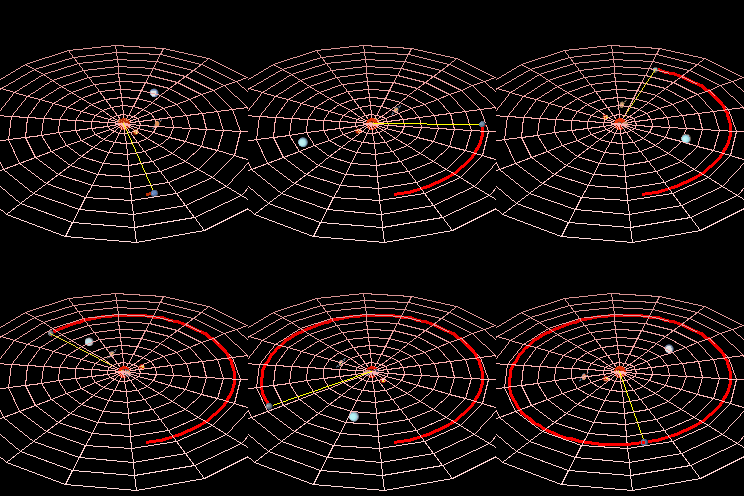
Neptune isn’t alone in its cosmic dance. It is accompanied by a retinue of 14 known moons, each named after figures from Greek and Roman mythology. The largest and most famous of these is Triton, a frozen world that stands out for its retrograde orbit, meaning it orbits Neptune in the opposite direction of the planet’s rotation. This suggests that it may once have been an independent object that Neptune captured. Triton is also the only moon in our solar system known to have active geysers erupting with ice and nitrogen, which were spotted by the Voyager 2 spacecraft, the only human-made spacecraft to reach Neptune. Triton was discovered on Oct. 10, 1846, by William Lassell, just 17 days after Johann Gottfried Galle discovered the planet.

A time-lapse video of Neptune and its moons
Ringing in the Mysteries
Adding to Neptune’s allure are its faint, dusty rings. Unlike the bright and prominent rings of Saturn, Neptune’s rings are wispy and barely visible even from powerful telescopes. They are composed of microscopic particles of ice and dust, and their existence hints at a complex and dynamic interplay of forces within the Neptunian system.


Birth of an ice-giant
Neptune was born 4.5 billion years ago, coalescing from swirling dust and gas, at which time it was likely closer to the Sun than its current icy home – just like Uranus. Over time, it migrated outward, becoming the distant king of the solar system’s cold realm.
As a layered marvel, ighty percent or more of the planet’s mass is made up of a hot dense fluid of “icy” materials – water, methane, and ammonia – above a small, rocky core. Of the giant planets, Neptune is the densest. And under that frozen surface, scientists suspect an ocean of super-hot water, which does not boil away because incredibly high pressure keeps it locked inside.

Neptune has no solid surface. Its gas-rich atmosphere (made up mostly of hydrogen, helium, and methane) extends to great depths, and blends seamlessly into deeper layers of melted ices, eventually reaching a rocky core as massive as Earth.


The air on this ice planet is a hydrogen-helium cocktail with a little bit of methane. This methane gives Uranus its blue-green hue, but Neptune’s secret ingredient paints a deeper, more vibrant blue. What is it? We do not know!

Neptune is our solar system’s windiest world. Even though it is so far away from the Sun, its winds reach hurricane-like speeds, three times stronger than Jupiter’s and a staggering nine times stronger than Earth’s mightiest gusts. These super storms fling frozen methane clouds across the planet at supersonic speeds (more than 1,200 miles per hour or 2,000 kilometres per hour). To compare, Earth’s most powerful winds hit only about 250 miles per hour (400 km per hour).

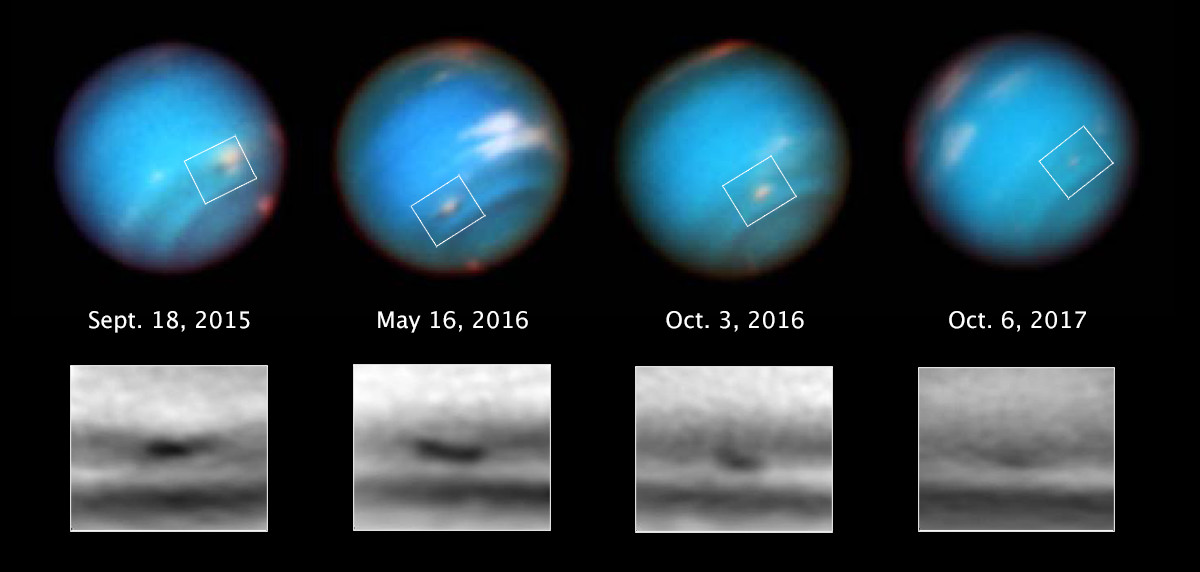
In 1989, Neptune’s southern hemisphere housed a colossal storm, the “Great Dark Spot,” big enough to swallow Earth whole. This soon vanished, leaving behind a legacy of ever-evolving weather patterns but new storms have appeared on different parts of the planet.


The study of this icey, windswept world continues to unravel the secrets of the outer solar system. Spacecraft like Voyager 2 have provided invaluable data and stunning images of the planet. The advent of the Hubble Space Telescope, large ground-based telescopes with adaptive optics and now the James Webb Space Telescope has allowed for additional detailed observations from afar.
But much remains unknown. From the source of its internal heat to the possibility of hidden oceans beneath its icy surface, Neptune beckons us to solve its mysteries.
All images by NASA.
Podcast: Play in new window | Download