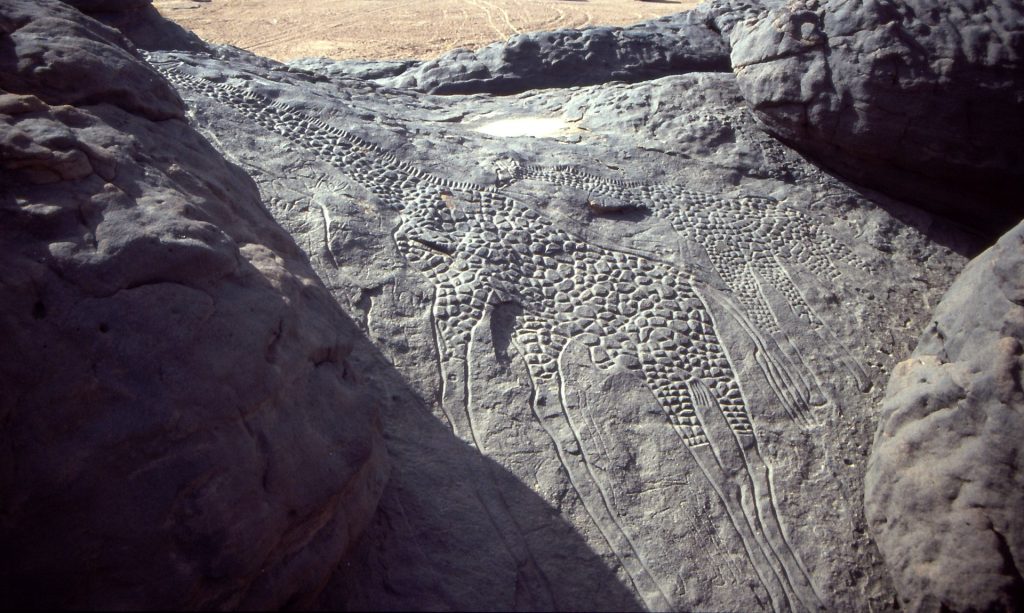
Deep in the heart of the Sahara Desert, amidst the scorching sands and towering dunes, lies a remarkable archaeological treasure – the Dabous Giraffes. They can be found on a sandstone outcrop in the TÁ©nÁ©rÁ© desert in the first foothills of the AÁ¯r Mountains in North Central Niger.

These gigantic giraffe carvings were first recorded by French archaeologist Christian Dupuy in 1987, and subsequently documented by David Coulson in 1997 who was on a photographic expedition to the site.
At an astonishing 6 meters (20 feet) in height, the Dabous Giraffes are the largest known animal petroglyphs in the world. Etched with intricate detail, these majestic carvings depict a male giraffe towering over a smaller female, showing off their elongated necks and distinctive patterns in stone. But the Dabous Giraffes are not the only wonders that adorn these ancient rock canvases. In the surrounding area, archaeologists have discovered a staggering 828 images engraved onto the sandstone, including depictions of cattle, ostriches, antelopes, lions, rhinoceroses, and even camels.

Each giraffe has a line coming down from its mouth and ending with a human figure, which some believe to depict a connection between humans and the animal world.

These carvings, believed to have been created between 6,000 and 8,000 years ago, offer a glimpse into the rich biodiversity that once thrived in this now-arid region, at a time when this part of Africa was humid and the Sahara was a vast savannah teeming with life. Our ancestors who lived in this area left their indelible mark on these rocks, allowing us to learn their stories and experiences. The presence of petrified wood in the area further attests to the lush environment that once existed here, a stark contrast to the barren desert we know today.
Since their discovery efforts have been made to preserve and protect these priceless petroglyphs, including the creation of a mold for display and the involvement of organisations like the Bradshaw Foundation.
[vc_column width=”1/2″]
[vc_column width=”1/2″]