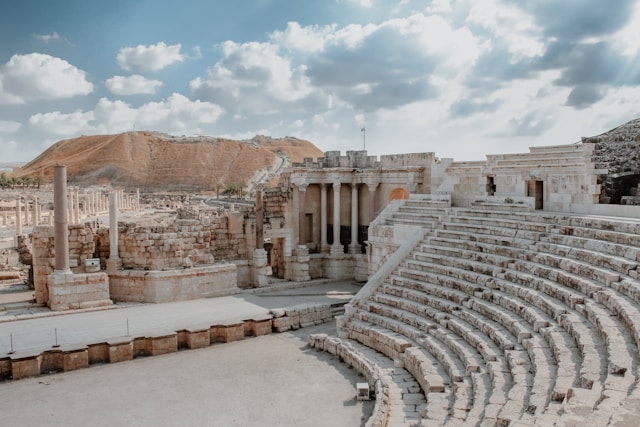
Roman builders were not chasing novelty — they were after permanence. Two millennia later, their work still dwarfs expectations for service life, offering clear guidance for today’s engineers who must balance durability with carbon-aware design.
The most vivid proof is Rome’s Pantheon — still welcoming visitors after 1,900 years under the world’s largest unreinforced concrete dome. Its endurance is rooted in a binder made from volcanic ash — pozzolana — and lime that reacts with water to form an exceptionally stable stone-like matrix.
Hot Mixing and the Mystery of Lime Clasts
A 2023 MIT-led study pushed the conversation further by showing that Roman masons likely tossed quicklime — not slaked lime — straight into their ash-and-water slurry at kiln-level temperatures.
The resulting “hot mixed” mortar trapped bright white lime clasts throughout the slab. When cracks appear, rainwater dissolves these clasts, reprecipitating calcium carbonate and sealing the fracture from the inside. Self-healing concrete is, therefore, not a futuristic gadget — it’s a rediscovered heritage technology.
How Today’s Concrete Mixtures Compare
Modern builders almost universally rely on Portland cement. It’s produced in rotary kilns and is finely ground, leaving no lime clasts to heal later damage. Even under ideal conditions, Portland-cement structures are expected to last only 75 to 100 years before significant repair or replacement — a respectable figure but paltry beside Roman benchmarks.
Lessons for the 21st Century
Roman practice is not a museum piece — it offers an actionable playbook. Before outlining that playbook, remember that conventional concrete can have impressive longevity — anywhere from 30 to 100 years, depending on mix design, placement and early moisture control. Minimising added water and cycling wet-dry curing tightens the pore structure and extends service life.
In that context, several principles emerge:
- Revive Pozzolanic Blends
Pozzolans are not exotic. Fly ash, natural pumice and calcined clays can mimic the Roman recipe while lowering Portland cement’s carbon footprint. Integrating more siliceous ash promotes long-term strength and sulphate resistance.
- Explore Hot Mix Techniques
Laboratory replications of Roman hot mixing show that entrained lime clasts can restore crack widths within weeks and drastically cut life-cycle maintenance. Pilot projects could validate the method at an industrial scale.
- Cure Actively
Frequent wetting during the first week encourages continued hydration and crystal growth. Pair this regimen with phased drying to prevent early shrinkage — the concrete will repay the effort over decades.
- Limit Mixing Water
Romans favoured dense, low-water pastes laid in thin lifts. Modern crews can achieve similar density by using high-range water reducers and controlling slump. Less water means fewer capillary cavities and fewer pathways for carbonation and chloride ingress.
- Design for Climate Resilience
Ancient harbour piers survived salt spray and wave impact because pozzolanic binders thrive in alkaline and mineral-rich environments. Similar sulphate-resistant and low-permeability mixes are essential today as sea-level rise and extreme storms threaten coastal infrastructure.
Building a Sustainable Future with Lessons from the Past
Roman engineers built for citizens not yet born — a mindset worth reclaiming. Incorporating pozzolans, experimenting with hot-mixed binders and enforcing disciplined curing can move present-day construction from disposable to enduring. Each ton of concrete that lasts centuries instead of decades reduces demand for new cement and the emissions that accompany it. The Pantheon is not just an artifact — it’s a provocation to build structures that future generations will inherit, not rebuild.