On 15 March 2024, a powerful solar flare and CME sparked auroras across the solar system. NASA’s Perseverance rover made history by detecting them on Mars — the first time ever from another planet’s surface.
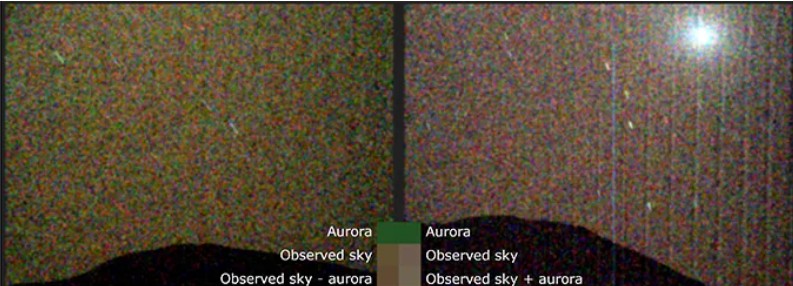
NASA’s Perseverance rover has captured the first visible-light image of an aurora on Mars, a green glow rippling across the martian sky. This event, triggered by a powerful solar flare and coronal mass ejection, confirmed long-held predictions about Martian auroras and marks the first time an aurora has been documented from the surface of another world. The image, taken on March 22, 2024, showcases the potential for auroras to be visible to future astronauts on Mars.
The Perseverance rover’s Mastcam-Z camera captured the green aurora, a result of solar energetic particles interacting with the Martian atmosphere.The aurora was triggered by a solar flare and coronal mass ejection that occurred on March 15, 2024, according to NASA Jet Propulsion Laboratory (JPL) news.The images confirm scientists’ predictions that auroras on Mars could be visible in visible light, opening new possibilities for research. Scientists have thought for years that green light auroras could exist on Mars but that they would be much fainter and harder to capture.
That is clear in the image, which is fuzzy and the reason for that is that the cameras aboard Perseverance do not perform as well at night, at which time the instruments are not drastically more sensitive than the human eye. Secondly, Mars magnetic field is also different from Earth’s. It doesn’t have a global magnetic field concentrated around the poles like we do. Rather, its crust is magnetised in patches, so the auroras appear everywhere on the planet but they appear dimmer than those on Earth.
According to NASA Press Release:
“Due to the Red Planet’s lack of a global magnetic field, Mars has different types of auroras than those we have on Earth. One of these is solar energetic particle (SEP) auroras, which NASA’s MAVEN (Mars Atmosphere and Volatile EvolutioN) mission discovered in 2014. These occur when super-energetic particles from the Sun hit the Martian atmosphere, causing a reaction that makes the atmosphere glow across the whole night sky.
While MAVEN had observed SEP auroras in ultraviolet light from orbit, this phenomenon had never been observed in visible light from the ground. Since SEPs typically occur during solar storms, which increase during solar maximum, Elise Knutsen, a postdoctoral researcher at the University of Oslo in Norway and her team set their sights on capturing visible images and spectra of SEP aurora from Mars’ surface at the peak of the Sun’s current solar cycle.
Through modeling, Knutsen and her team determined the optimal angle for the Perseverance rover’s SuperCam spectrometer and Mastcam-Z camera to successfully observe the SEP aurora in visible light. With this observation strategy in place, it all came down to the timing and understanding of CMEs.
“The trick was to pick a good CME, one that would accelerate and inject many charged particles into Mars’ atmosphere,” said Knutsen.”