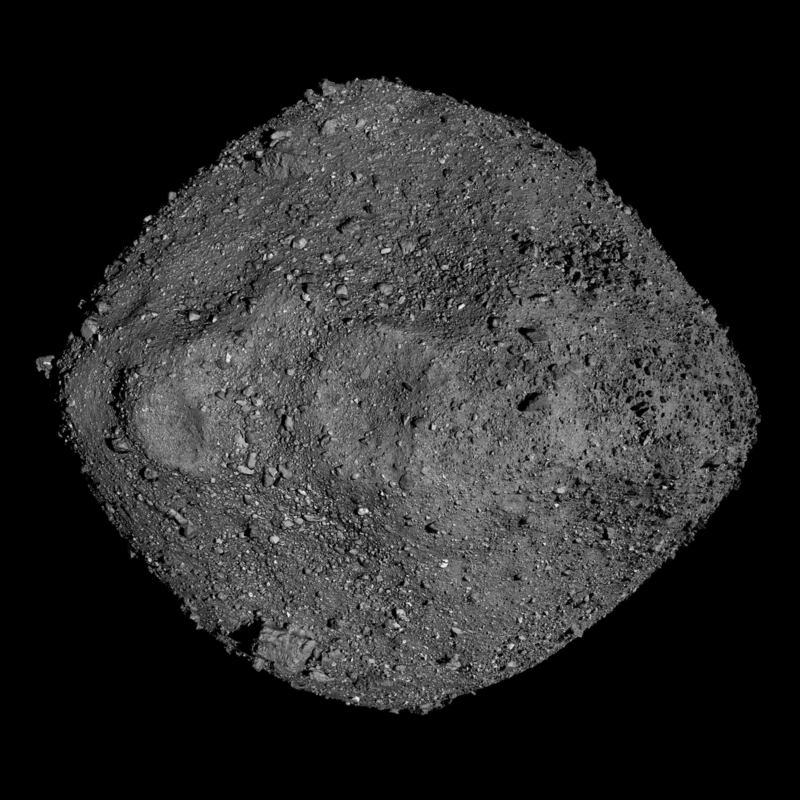
NASA’s spacecraft OSIRIS-Rex (the long-winded name is Origins, Spectral Interpretation, Resource Identification, Security, Regolith Explorer) got back after collecting samples from an asteroid! It returned on September 24, 2023. The exciting news then was that it brought back soil samples from the asteroid, which have been analysed by scientists since their return. And now we have more news! In latest news NASA revealed that the presence of organic compounds essential for life had been detected in the sample. These include amino acids, which are the building blocks of proteins, and nucleobases, the components of DNA and RNA. Additionally, minerals formed from evaporated brine were identified, suggesting that Bennu’s parent body once harbored liquid water. These findings support the theory that asteroids like Bennu may have delivered the raw materials necessary for life to early Earth.
The Mission
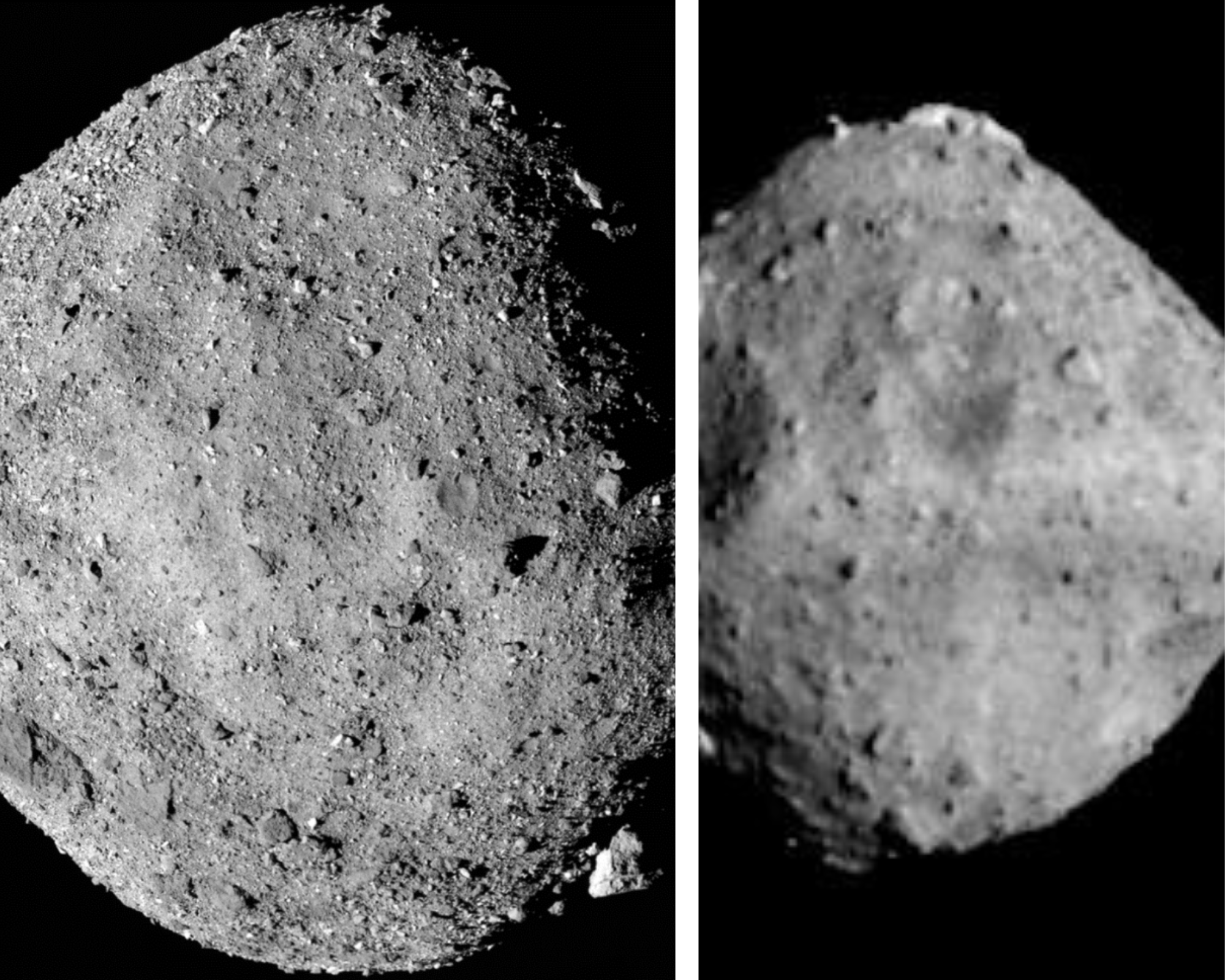
OSIRIS REx’s very cool objective was to travel to near-Earth asteroid Bennu (also called 1999 RQ36) and bring back a sample of between 60 grams to 2 kg of Bennu’s black, carbon rich surface material. Launched in September 2016, OSIRIS-REx rendezvoused with Bennu in December 2018. On board, it had telecommunication equipment, but more importantly, it carried instruments to study the asteroid in many wavelengths, take images and of course retrieve a soil sample. This is not the only one, we’ve also had other asteroid sampling missions such as the Japanese Hyabusa to Ryugu.
Science communication fun fact
The Planetary Society in the US, organised a campaign for people to have their names or artwork saved on a microchip, which the spacecraft now carries. Also, Bennu was named by nine-year-old Michael Puzio, who won a contest to name the asteroid. Bennu is the ancient Egyptian deity linked with the Sun, creation and rebirth — Puzio noted that Bennu is the living symbol of Osiris. The myth of Bennu suits the asteroid itself, given that it is a primitive object that dates back to the creation of the Solar System.
Soil Collection
When OSIRIS-REx entered Bennu’s orbit in December 2018 at approximately 1.75 km (1.09 mi), it started remote sensing and mapping exercises to select a sample site. At this altitude, it takes the spacecraft 62 hours to orbit Bennu. At the end of a detailed survey, it entered a closer orbit with a radius of 1 km (0.62 mi).
As if visiting asteroids and collecting soil samples wasn’t enough, OSIRIX REx overachieved its mission and November 11, 2019. While its instruments were performing detailed scientific observations of Bennu, it captured X-rays radiating from a point off the asteroid’s edge. The X-rays were being emitted by a newly flaring blackhole binary, 30,000 light years away, discovered just a week earlier by Japan’s MAXI telescope.
In December 2019, after analysing the surface of the asteroid for a target sample area, the team leading the mission selected a collection site out of four candidates. They called this site Nightingale, located in a crater in the northern hemisphere. Finally, in October 2020 OSIRIS REx successfully retrieved a sample from the surface of the asteroid.
Video highlighting a sample of the images, the asteroid’s many varied features including giant boulders and the soil sample collection event.
After spending two years in orbit, on April 9, 2021, it took one last look at Bennu and on May 10, 2021 embarked on its return voyage to Earth. As OSIRIS REx left Bennu it captured one last photo of the asteroid as a crescent- which can be seen below- as the spacecraft flies away.

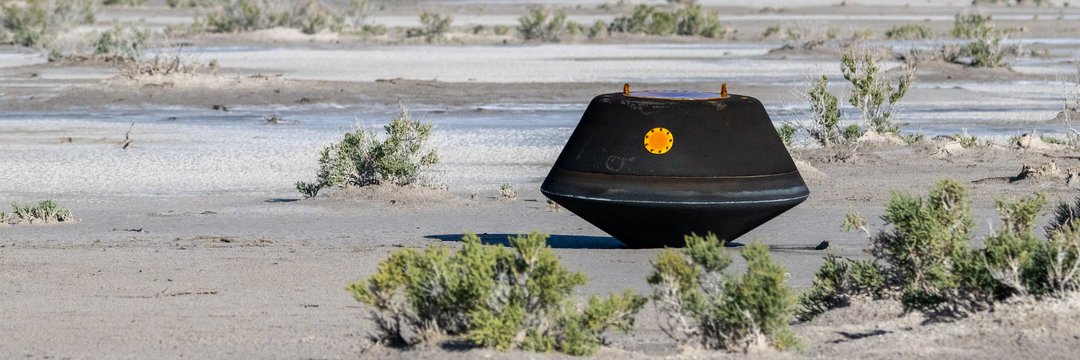
After a 1.2 billion-mile journey, which included going around the Sun twice, OSIRIS-REx returned to Earth on September 24, when it jettisoned a sealed capsule containing the sample. This landed under a parachute at the US Air Force’s Utah Test and Training Range. The samples is being analysed at NASA’s Astromaterials Research and Exploration Science Directorate (ARES). The spacecraft itself will not return, there are plans for its journey to continue. Its navigators plan to send it onwards to asteroid Apophis in April 2029, when that asteroid is only 20,000 miles from Earth.
After, the capsule was dropped safely in the Utah desert, it was then transported to the temporary clean room at the Utah Test and Training Range. It is now in Houston at NASA’s Johnson Space Center.


The Sample
Within the first two weeks, scientists performed “quick-look” analyses of that initial material, collecting images from a scanning electron microscope, infrared measurements, X-ray diffraction, and chemical element analysis. X-ray computed tomography was also used to produce a 3D computer model of one of the particles, highlighting its diverse interior. This early glimpse provided the evidence of abundant carbon and water in the sample.


Exciting Analysis
We can now undoubtedly get amazing science as the soil samples are analysed, just like that from Hyabusa2. Analysis of that soil showed that it was older than the planets and contained the building blocks of life. And this has already started happening, with the Bennu samples too.
Recent analyses of samples have revealed the presence of organic compounds essential for life. These include amino acids, which are the building blocks of proteins, and nucleobases, the components of DNA and RNA. Additionally, minerals formed from evaporated brine were identified, suggesting that Bennu’s parent body once harbored liquid water. These findings support the theory that asteroids like Bennu may have delivered the raw materials necessary for life to early Earth. Among the key findings were 14 of the 20 amino acids essential for life on Earth and all five nucleobases needed for DNA and RNA. Scientists also found high levels of ammonia, which, along with detected formaldehyde, can help form amino acids under the right conditions. These biomolecules, previously found in extraterrestrial rocks, now confirmed in a pristine space sample, support the idea that distant solar system objects may have supplied the raw ingredients for life. According to NASA: “The findings do not show evidence for life itself, but they do suggest the conditions necessary for the emergence of life were widespread across the early solar system, increasing the odds life could have formed on other planets and moons.”
“NASA’s OSIRIS-REx mission already is rewriting the textbook on what we understand about the beginnings of our solar system,” said Nicky Fox, associate administrator, Science Mission Directorate at NASA Headquarters in Washington. “Asteroids provide a time capsule into our home planet’s history, and Bennu’s samples are pivotal in our understanding of what ingredients in our solar system existed before life started on Earth.”
“The clues we’re looking for are so minuscule and so easily destroyed or altered from exposure to Earth’s environment,” said Danny Glavin, a senior sample scientist at NASA’s Goddard Space Flight Center in Greenbelt, Maryland, and co-lead author of the Nature Astronomy paper. “That’s why some of these new discoveries would not be possible without a sample-return mission, meticulous contamination-control measures, and careful curation and storage of this precious material from Bennu.”
While Glavin’s team searched for life-related compounds in Bennu samples, researchers led by Tim McCoy and Sara Russell studied the environment where these molecules formed. Published in Nature, their findings reveal an ancient setting ideal for life’s chemistry. They identified 11 minerals, including calcite, halite, and sylvite, formed as water evaporated, leaving behind crystallized salt.
While we have got so many answers from the Bennu sample, there are no doubt still more questions. According to NASA: “Many amino acids can be created in two mirror-image versions, like a pair of left and right hands. Life on Earth almost exclusively produces the left-handed variety, but the Bennu samples contain an equal mixture of both. This means that on early Earth, amino acids may have started out in an equal mixture, as well. The reason life “turned left” instead of right remains a mystery.”
The research detailing these discoveries was published in the journals Nature and Nature Astronomy in January 2025
All images and clips from NASA/Goddard/University of Arizona.
A part of this article was previously published on May 12, 2021 and updated on September 26, 2023.
Title Music: Hovering Thoughts by Spence from YouTube Audio Library
Video Music: His Last Share of The Stars by Doctor Turtle (FreeMusic Archive)
I hope you enjoy the post and video. You can subscribe to the You Tube Channel for more on science, history and nature and please do check out the website and follow on social media: Twitter // Instagram // Facebook // Reddit // Tiktok. You can check out the audio podcast on: Apple Podcasts // Stitcher // TuneIn // Spotify