Iapetus is one of Saturn’s most intriguing moons, known for its striking two-tone appearance, with one hemisphere dark and the other bright. It has a highly inclined and slightly eccentric orbit, making it stand out among Saturn’s moons. It also features a unique equatorial ridge, giving it the appearance of a walnut.
The planet Saturn is one of the most gorgeous things in our night sky. When seen through the telescope, its rings give it a unique structure amongst all the others in our solar system. But the rings are Saturn’s not only claim to fame. It also has the largest number of moons in the solar system; 145 known moons at the last count, with Titan being the largest and most well-known. Titan is larger than the planet Mercury and has its own atmosphere. It is also the only other moon where humans have landed a spacecraft. There are still some moons of Saturn awaiting confirmation and further study, so the number could rise as new discoveries are made.
Scientists think that the moons of Saturn formed through co-accretion, a process similar to the one that formed our entire solar system. During their early formation gas giants like Saturn were surrounded by discs of material that slowly coalesced into moons.
Discovery
Another one of Saturn’s moons also warrants mention. This one is Iapetus the outermost of Saturn’s large moons. And with an estimated diameter of 1,469 km (913 mi), it is the third-largest moon of Saturn (after Titan and Rhea) and the eleventh-largest in the Solar System.
It was named after the Titan Iapetus, (son of Uranus and Gaia and in the Bible linked to Japheth one of the sons of Noah). As the father of Prometheus, the ancient Greeks regarded Iapetus as the father of the human race. It was discovered in October 1671 by Italian born French astronomer Giovanni Domenico Cassini, after whom the latest mission to the Saturnian system was named.

Cassini observed, correctly it turns out, that Iapetus has a bright hemisphere and a dark hemisphere, and that it is tidally locked, which means it always keeps the same face towards Saturn (our moon does the same). This means that the bright hemisphere is visible from Earth when Iapetus is on the western side of Saturn, and the dark hemisphere is visible when Iapetus is on the eastern side.

Formation
It was initially thought that unlike other moons Titan was formed in a series of giant impacts between pre-existing moons. Iapetus and Rhea are thought to have formed from part of the debris of these collisions. However, recent studies suggest that all of Saturn’s moons inward of Titan are no more than 100 million years old. Therefore, Iapetus is unlikely to have formed in the same series of collisions as Rhea and all the other moons inward of Titan. Both Iapetus and Titan in fact may be primordial satellites.
Composition
Iapetus has a relatively low-density structure comprising mostly of ice, with only a small (~20%) amount of rocky materials. It has several distinctive features, including the aforementioned striking difference in colouration between its leading hemisphere, which is dark, and its trailing hemisphere, which is bright. It also has a massive equatorial ridge running three-quarters of the way around the moon. So, unlike most of the large moons, its overall shape is neither spherical nor ellipsoid, but bulges at the centre with squashed poles in the north and south.


The unique equatorial ridge is so high that it visibly distorts Iapetus’s shape even when viewed from a distance. All of these features give a distinctly walnut shape to the moon.
According to NASA: “The second most notable feature of Iapetus is its “equatorial ridge,” a chain of 6-mile (10-km) high mountains girdling the moon’s equator. On the anti-Saturnian side of Iapetus, the ridge appears to break up and distinct, partially bright mountains are observed. The Voyager I and Voyager II encounters provided the first knowledge of these mountains, and they are informally referred to as the Voyager Mountains. There are two theories on how the ridge formed. Some scientists think the ridge was formed at an earlier time when Iapetus rotated much faster than it does today; others think the ridge is made of material left from the collapse of a ring.”
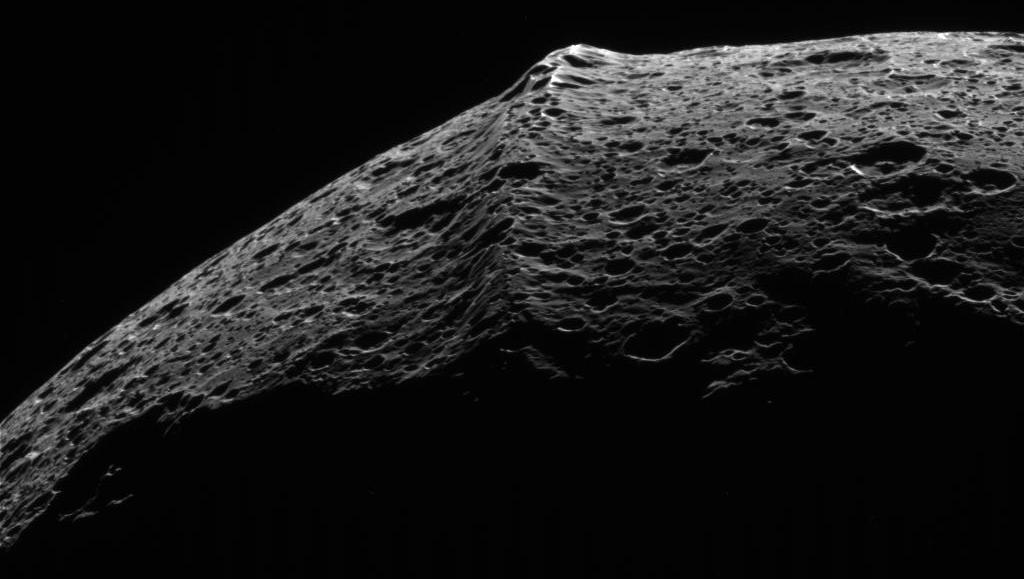

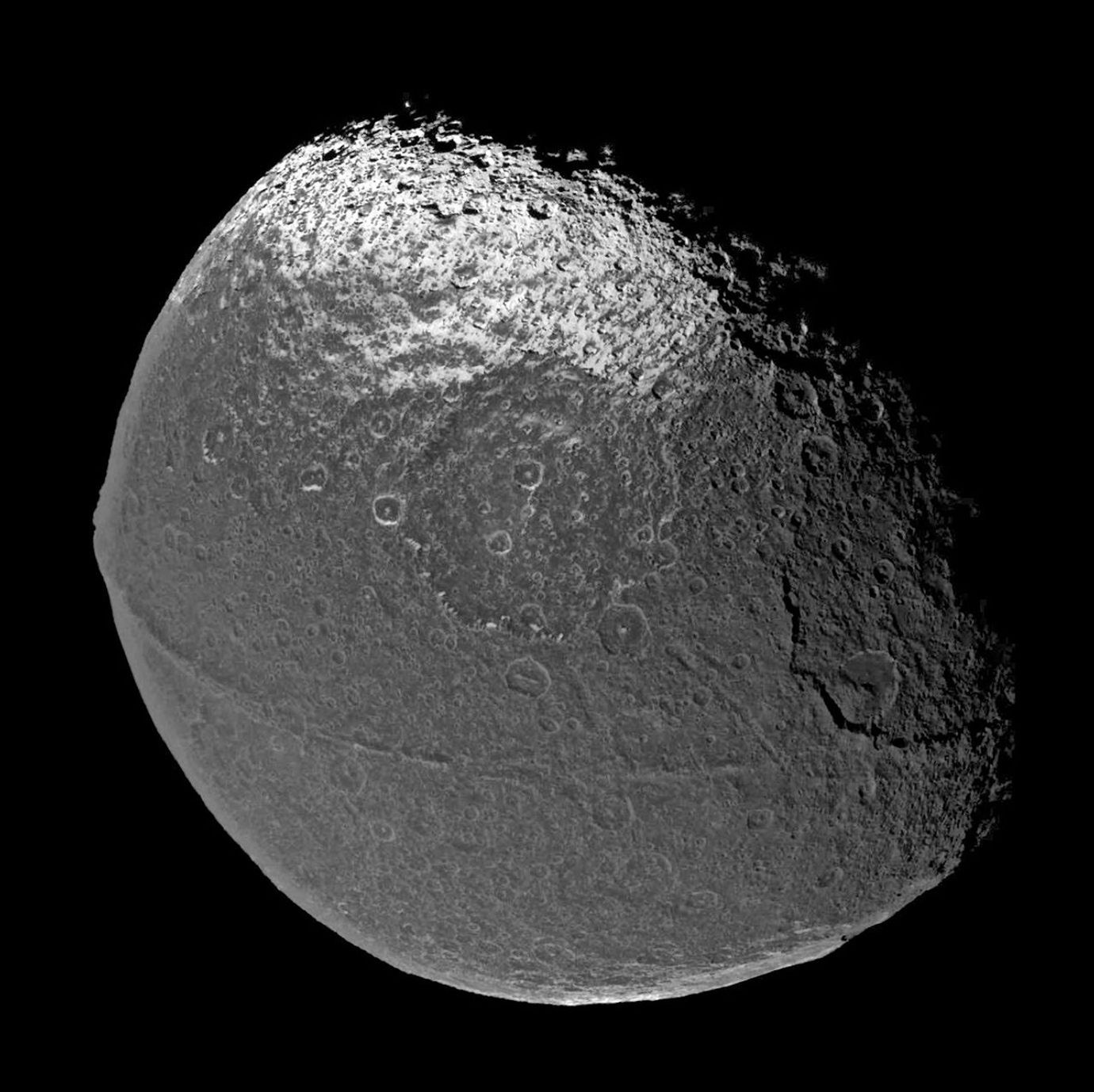
Iapetus is also heavily cratered. Images captured by the Cassini mission (which orbited the Saturnian system for 13 years, from July 1, 2004 until September 15, 2017) have revealed large impact basins, at least five of which are over 350 km (220 mi) wide. The largest of these is Turgis with a diameter of 580 km (360 mi). Turgis has an extremely steep rim and a scarp about 15 km (9.3 mi) high. Iapetus is known to support long-runout rock avalanches/landslides known as sturzstroms, possibly supported by ice sliding.
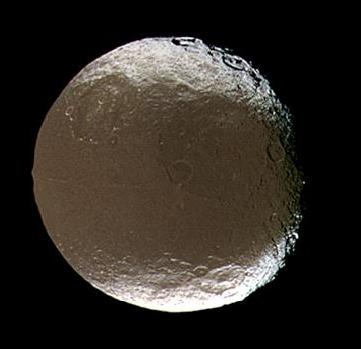
The colour contrast between the two hemispheres of Iapetus is striking. The leading hemisphere and its sides are dark with a faint reddish-brown tint, while the majority of the trailing hemisphere and the poles are bright. As a result, the apparent magnitude of the trailing hemisphere is around 10.2, whereas the leading hemisphere has a magnitude of about 11.9, making it beyond the capability of the best telescopes in the 17th century. The dark region is called Cassini Regio, while the bright region is split into Roncevaux Terra to the north of the equator and Saragossa Terra to the south.
Scientists think that Iapetus’s unusual two-tone appearance could be caused by the way its leading hemisphere collects dust and debris from nearby moons and Saturn’s rings, which darkens it. Iapetus collects debris primarily from Saturn’s moon Phoebe. Phoebe orbits Saturn in a retrograde direction and is believed to be a source of dust and debris that is captured by Iapetus, especially on its leading hemisphere. Basically, it throws out debris that is captured by Iapetus and settles as a dark layer on its surface. This process contributes to the darkening of Iapetus’s surface in that region. Additionally, material from Saturn’s rings can also play a role in this accumulation of debris. The darker material, possibly rich in carbon, contrasts sharply with the moon’s bright, ice-covered trailing hemisphere. Additionally, some believe the dark regions could be remnants of ancient volcanic activity or material from the surrounding space environment.
While the dark material is thought to have originated from outside Iapetus possibly as debris from Phoebe and Saturn’s rings, it now mainly consists of residues from the sublimation (evaporation) of ice from the warmer regions of the moon’s surface, further darkened by exposure to sunlight; the result of a process called “space weathering.” The moon’s surface experiences constant bombardment by charged particles from the Sun, which could darken its icy surface over time.
According to NASA: “The September 2007 Cassini flyby of Iapetus showed that a third process, thermal segregation, is probably the most responsible for Iapetus’ dark hemisphere. Iapetus has a very slow rotation, longer than 79 days. Such a slow rotation means that the daily temperature cycle is very long, so long that the dark material can absorb heat from the sun and warm up. (The dark material absorbs more heat than the bright icy material.) This heating will cause any volatile, or icy, species within the dark material to sublime out, and retreat to colder regions on Iapetus. This sublimation of volatiles causes the dark material to become even darker — and causes neighboring bright, cold regions to become even brighter. Iapetus may have experienced a (possibly small) influx of dark material from an external source, which could have warmed up and triggered this thermal segregation process.”
The dark material contains organic compounds similar to those found in primitive meteorites or on comet surfaces. Earth-based observations have confirmed it to be carbonaceous and likely includes cyano-compounds, such as frozen hydrogen cyanide polymers.

Orbit
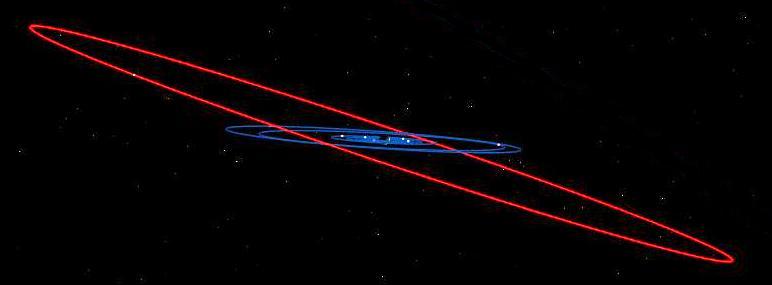
Iapetus has a unique orbit. It orbits Saturn at an average distance of about 3.56 million kilometres. Unlike most moons, Iapetus has a highly inclined orbit, tilted about 15 degrees relative to Saturn’s equator. Its orbit is also slightly eccentric, meaning that its distance from Saturn varies slightly during its orbit. This eccentricity, combined with its orbital inclination, results in unusual features like its distinct hemispheric colour contrast believed to be influenced by its orbit and interaction with Saturn’s rings and other moons. The combination of these orbital characteristics contributes to the moon’s unusual and fascinating appearance.
Exploration
Pioneer 11 was the first spacecraft to visit Saturn and passed by Iapetus on September 1, 1979. However, it did not capture any images of Iapetus and came no closer than 1,030,000 km (640,000 mi) from the moon. However, it marked humanity’s first attempt to gather direct measurements from objects within the Saturnian system.
On November 12, 1980, Voyager 1 arrived at Saturn and became the first probe to return images of Iapetus, revealing its striking two-tone appearance from a distance of 2,480,000 km (1,540,000 mi) as it exited the Saturnian system.

Voyager 2 followed on August 22, 1981, making its closest approach to Iapetus at a distance of 909,000 km (565,000 mi). It captured photos of the moon’s north pole as it entered the Saturnian system, in the opposite direction to Voyager 1’s approach. One notable image showed the Roland crater at the terminator.

The most recent probe to visit Iapetus was the Cassini orbiter, which entered orbit around Saturn on July 1, 2004. While Cassini captured numerous images of Iapetus from moderate distances, the moon’s significant distance from Saturn made close-up observations challenging. But it did capture some amazing images that tell us a lot about this intriquing moon.