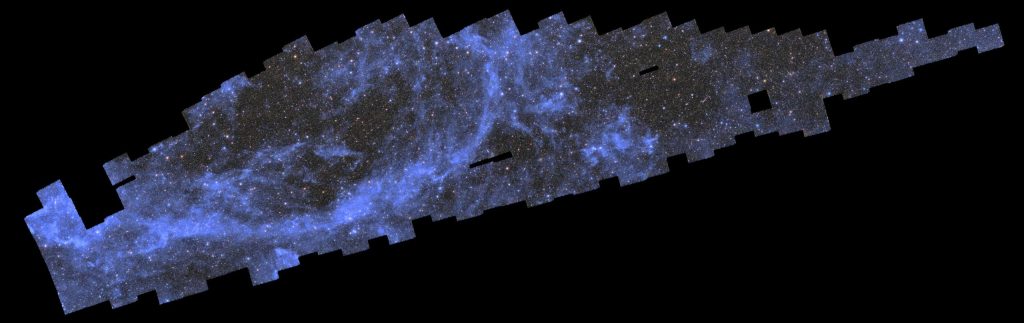
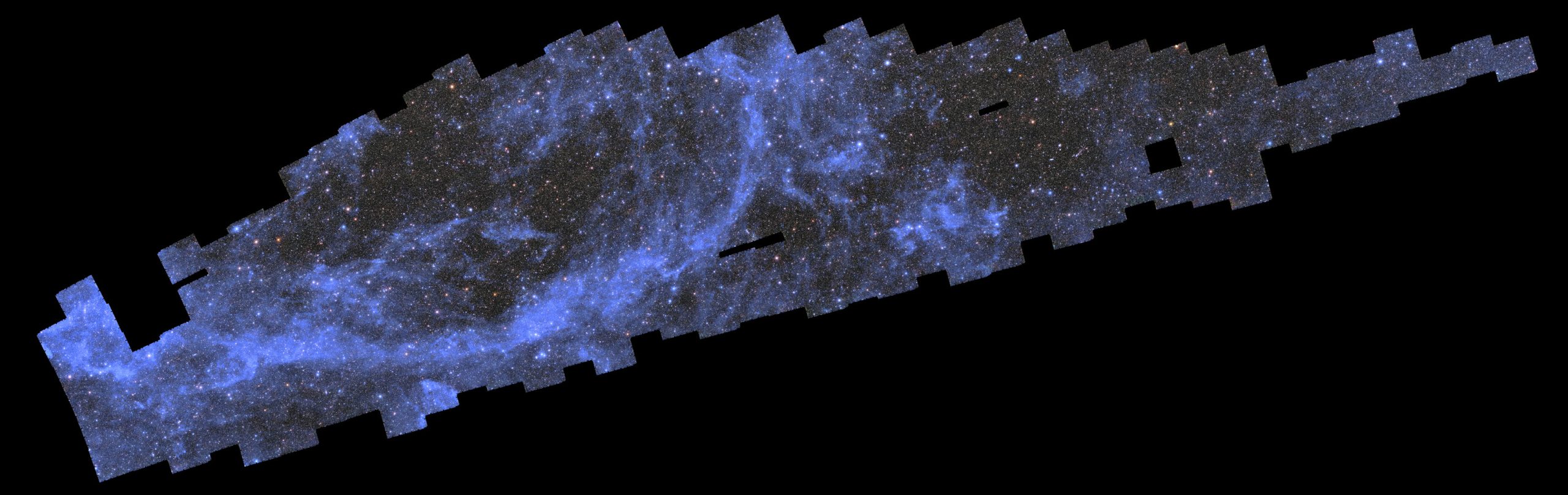
The European Space Agency’s Euclid telescope has revealed a stunning mosaic of over 14 million galaxies, offering a glimpse into its groundbreaking mission to map the universe. This first release, captured during a two-week survey in April, covers an area more than 500 times the area of the sky covered by a full Moon and represents just 1% of the final map.
The mosaic contains 260 observations in visible and infrared light made between March 25 and April 8 of this year. In just two weeks, Euclid covered 132 square degrees of the southern sky.
The image showcases the vastness of the cosmos, with swirling galaxies hundreds of millions of light years away, some harbouring supermassive black holes.
A wispy blue band known as “galactic cirrus” from our own Milky Way adds a striking foreground detail. These are clouds of gas and dust located between the stars in our own galaxy. Sometimes called “galactic cirrus” because they look like cirrus clouds at Earth, these clouds can be observed by Euclid’s visible-light camera because they reflect visible light from the Milky Way.
“What really strikes me about these new images is the tremendous range in physical scale,” said JPL’s Mike Seiffert, project scientist for the NASA contribution to Euclid. “The images capture detail from clusters of stars near an individual galaxy to some of the largest structures in the universe. We are beginning to see the first hints of what the full Euclid data will look like when it reaches the completion of the prime survey.”
“We have already seen beautiful, high-resolution images of individual objects and groups of objects from Euclid. This new image finally gives us a taste of the enormity of the area of sky Euclid will cover, which will enable us to take detailed measurements of billions of galaxies,” said Jason Rhodes, an observational cosmologist at NASA’s Jet Propulsion Laboratory in Southern California who is the U.S. science lead for Euclid and principal investigator for NASA’s Euclid dark energy science team.
Over the next six years, Euclid will autonomously scan a third of the night sky, charting 8 billion galaxies across 10 billion years of cosmic history. This ambitious project will help scientists unlock the secrets of dark matter and dark energy, shaping our understanding of the universe’s structure and evolution.
Video and image: European Space Agency (ESA/Euclid/Euclid Consortium/NASA, CEA Paris-Saclay, image processing by J.-C. Cuillandre, E. Bertin, G. Anselmi)
Podcast: Play in new window | Download