A disk, a star, its planet and a moon

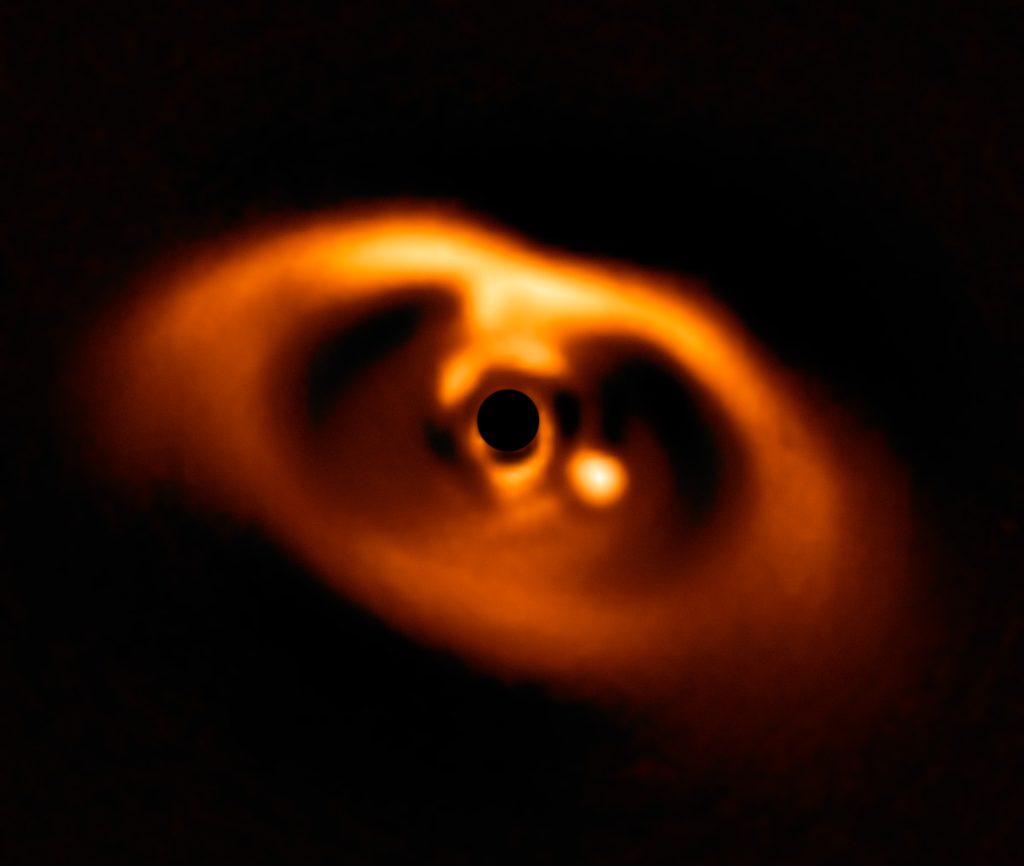
Meet PDS 70 (aka V1032 Centauri) – a young T Tauri star shining bright in the Centaurus constellation, 370 light-years away! At just 5.4 million years old, this baby star has 0.76 times the mass of our Sun and is surrounded by a stunning protoplanetary disk.
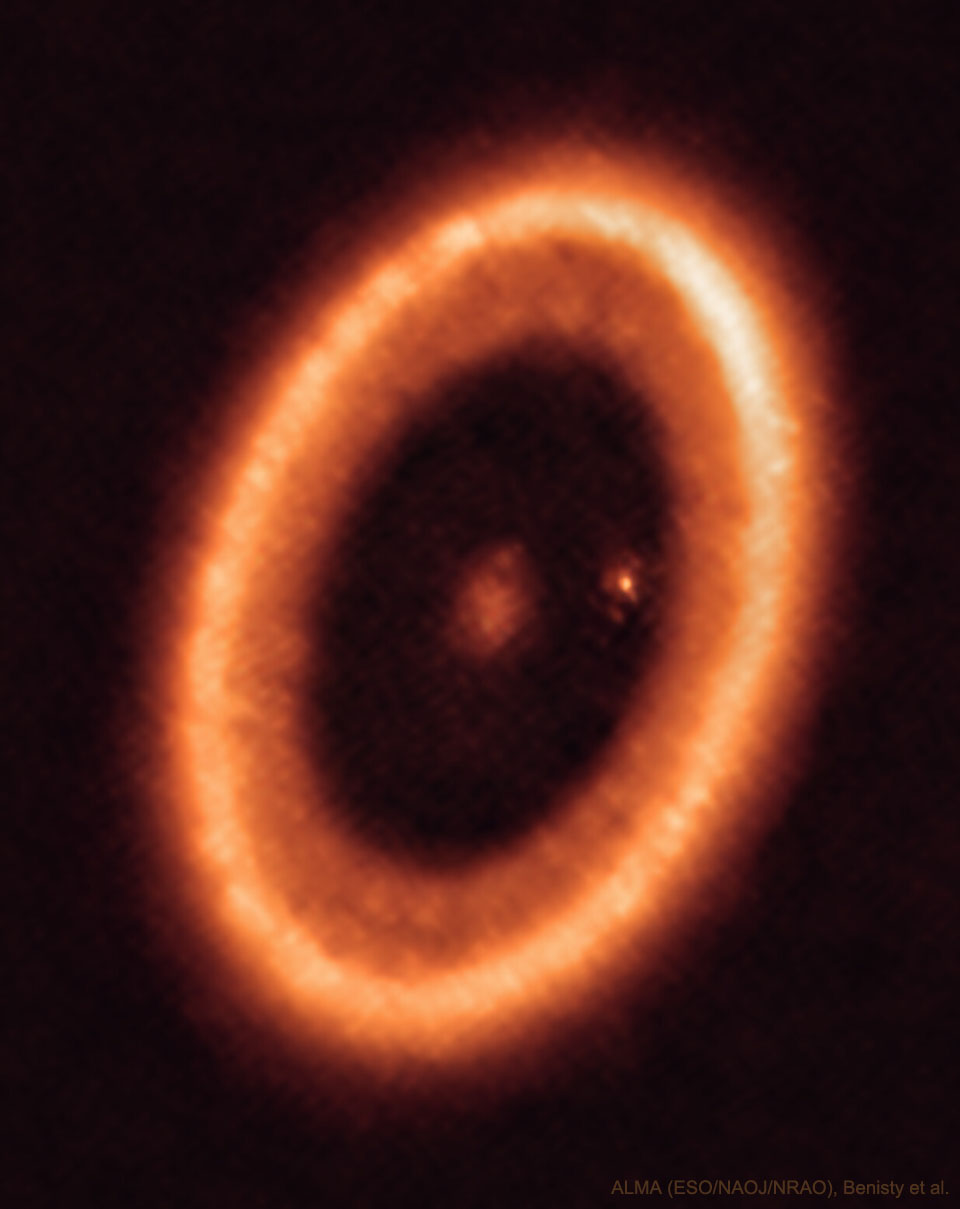
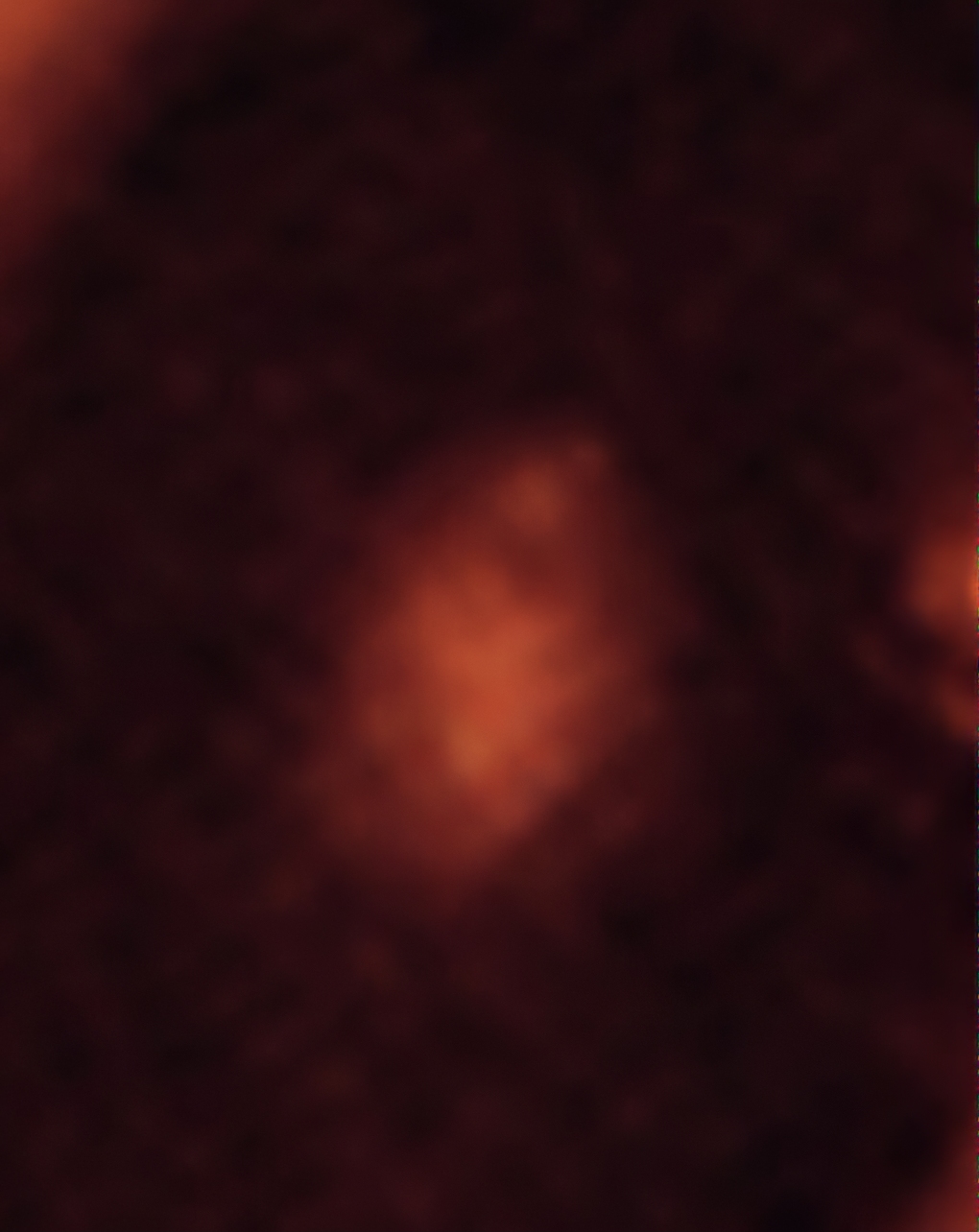
This image, taken with the Atacama Large Millimeter/submillimeter Array (ALMA), in which ESO is a partner, shows wide (left) and close-up (right) views of the moon-forming disc surrounding PDS 70c, a young Jupiter-like planet nearly 400 light-years away. The close-up view shows PDS 70c and its circumplanetary disc centre-front, with the larger circumstellar ring-like disc taking up most of the right-hand side of the image. The star PDS 70 is at the centre of the wide-view image on the left. Two planets have been found in the system, PDS 70c and PDS 70b, the latter not being visible in this image. They have carved a cavity in the circumstellar disc as they gobbled up material from the disc itself, growing in size. In this process, PDS 70c acquired its own circumplanetary disc, which contributes to the growth of the planet and where moons can form. This circumplanetary disc is as large as the Sun-Earth distance and has enough mass to form up to three satellites the size of the Moon.
This image, taken with the Atacama Large Millimeter/submillimeter Array (ALMA), in which ESO is a partner, shows wide (left) and close-up (right) views of the moon-forming disc surrounding PDS 70c, a young Jupiter-like planet nearly 400 light-years away. The close-up view shows PDS 70c and its circumplanetary disc centre-front, with the larger circumstellar ring-like disc taking up most of the right-hand side of the image. The star PDS 70 is at the centre of the wide-view image on the left. Two planets have been found in the system, PDS 70c and PDS 70b, the latter not being visible in this image. They have carved a cavity in the circumstellar disc as they gobbled up material from the disc itself, growing in size. In this process, PDS 70c acquired its own circumplanetary disc, which contributes to the growth of the planet and where moons can form. This circumplanetary disc is as large as the Sun-Earth distance and has enough mass to form up to three satellites the size of the Moon. ALMA (ESO/NAOJ/NRAO)/Benisty et al.


PDS 70
PDS 70

What’s cooler? It’s home to two forming exoplanets, PDS 70b and PDS 70c, both directly imaged by the European Southern Observatory’s Very Large Telescope. PDS 70b even made history as the first confirmed protoplanet to be directly captured in an image.

But PDS 70c is the real star of the show because it has moons forming below it in this fuzzy area.

A fuzzy area where moons are forming
A fuzzy area where moons are forming below exoplanet PDS 70c

It was imaged in 2021 by the Atacama Large Millimeter Array (ALMA) of 66 radio telescopes in the high Atacama Desert of northern Chile.

(Featured image: ESO/A. MÁ¼ller et al.)

Become a Patron!

Saima Baig

I am a Chartered Environmentalist from the Royal Society for the Environment, UK and co-owner of DoLocal Digital Marketing Agency Ltd, with a Master of Environmental Management from Yale University, an MBA in Finance, and a Bachelor of Science in Physics and Mathematics. I am passionate about science, history and environment and love to create content on these topics.

Connect

Support Us On Patreon!

Digital Magazine 360 on History
Newsletter
Please enable JavaScript in your browser to complete this form.

Subscribe to our newsletter and stay updated..

Provide your email address to subscribe. For e.g abc@xyz.com
You may unsubscribe at any time using the link in our newsletter.

Subscribe to Podcast