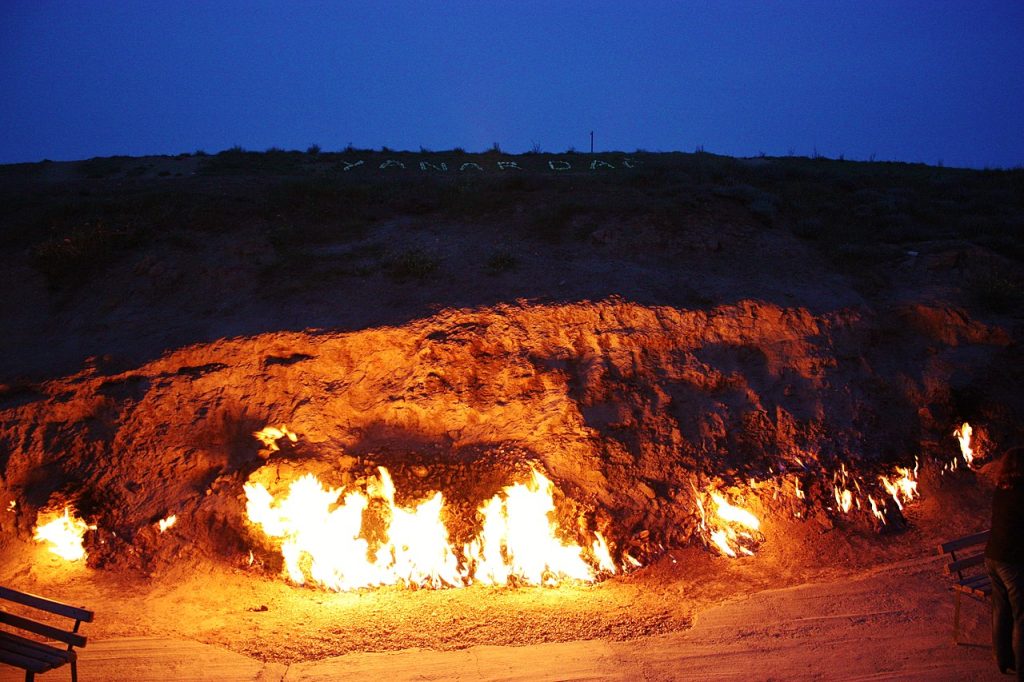
Think of mountains burning with fire constantly. It’s enought to make you think of the fires of hell. But this is not just a story – such a place does exist.
It is called Yanar Dagh and it is a natural gas fire which blazes continuously on a hillside on the Absheron Peninsula on the Caspian Sea near Baku, the capital of Azerbaijan. Azerbaijan itself is known as “the Land of Fire”. And this is not just small little fires across the countryside, these are flames that jet 3 metres (9.8 ft) into the air from a thin, porous sandstone layer.
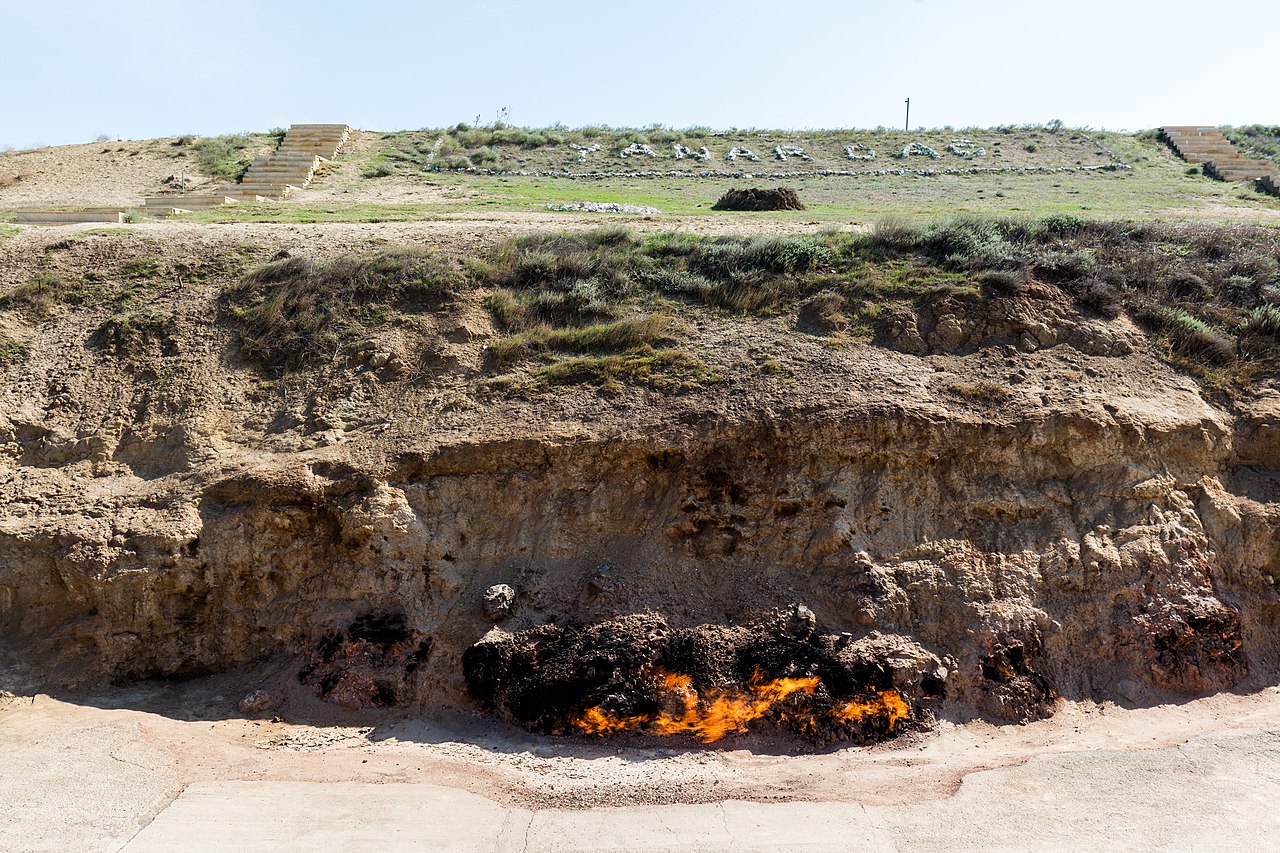
The legend goes that the Yanar Dagh flame was only noted when accidentally lit by a shepherd in the 1950s. It is is different from the nearby mud volcanoes of Lokbatan or Gobustan because it burns fairly steadily and constantly, fed by gas constantly seeping from the subsurface. The flames emanate from vents in sandstone formations and and some of them are said to rise to a height of 10 metres (33 ft) at the base of a 10-metre-wide (33 ft) scarp below a hillside.
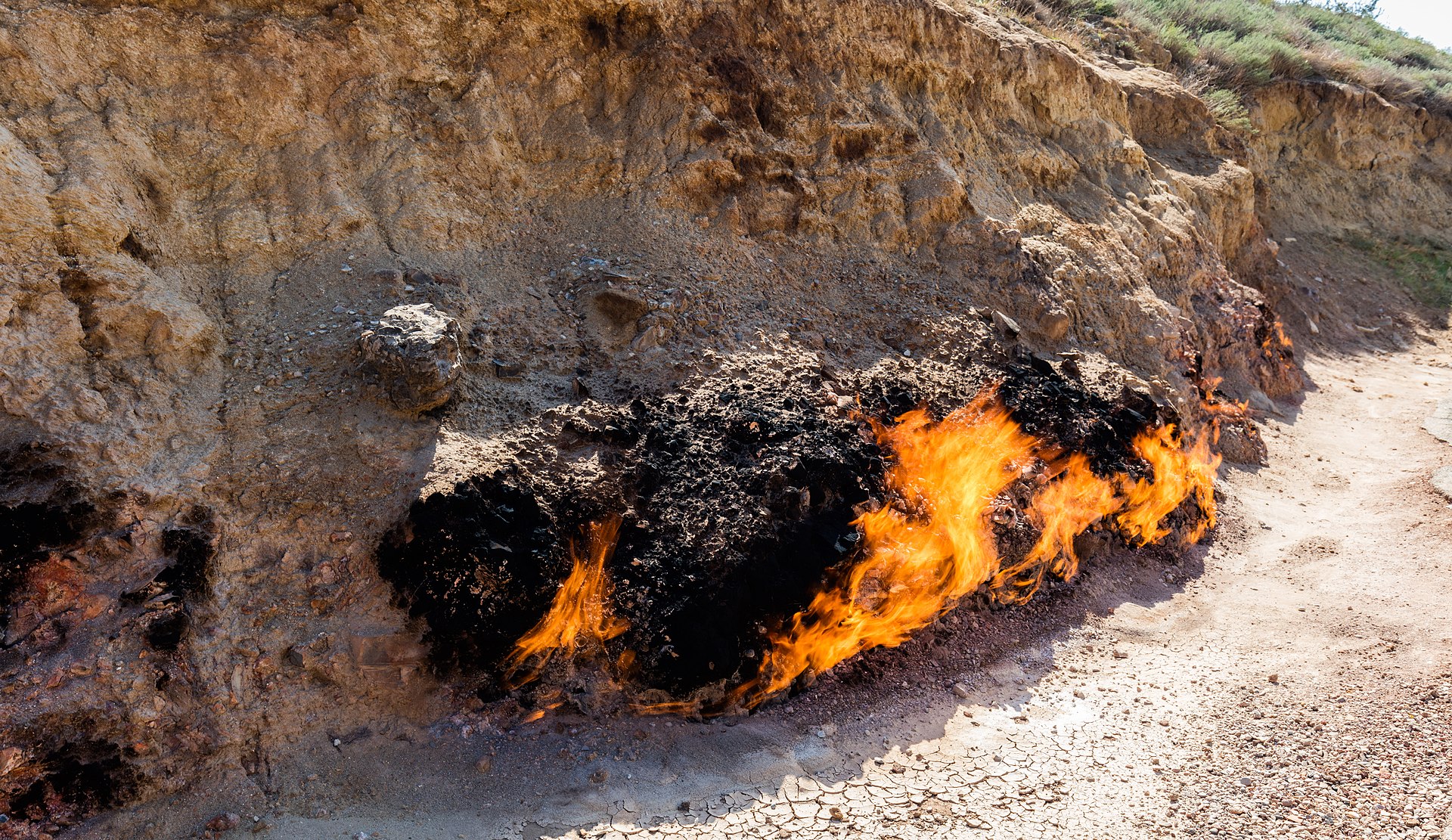
According to the Geological Survey of Azerbaijan, these are “Intensive flames, to 1 metre (3 ft 3 in) high, develop for 15 metres (49 ft) along the base of a 2-4-metre-high (6.6-13.1 ft) and 200-metre-long (660 ft) tectonic scarp.”
And it’s not just the sandstone surface, even on the surface of streams near Yanar Dagh – known as Yanar Bulag – fire can be ignited with a match. Yanar Bulag means “burning springs”. Local people take curative baths in the many springs around the vicinity of the Vileshchay River, because they are said to have healing properties.
The reason offered for the Yanar Dagh fires is the result of hydrocarbon gases emanating from below the Earth’s surface. Research conducted by the Geological Survey of Azerbaijan has shed light on the geological processes behind Yanar Dagh’s continuous flames. Analysis of samples from the site revealed that the highest gas flux occurs at the upper edge of the fault scarp, precisely where the flames are visible. Microseepage measurements showed values around 1,000 mg per square meter per day, recorded about 30 meters from the fire zone. Scientists believe the actual degassing area extends beyond the measured region, with gas likely seeping through the entire fault zone. This fault is considered part of the larger Balakhany-Fatmai geological structure that spans the Absheron Peninsula.
These fires are not like the mud volcanoes, most of which are located off the Bakuâ€Shamakhy road, about 40 kilometres (25 mi) from the city of Baku.
Both Alexandre Dumas and Marco Polo described the fires. Dumas, when he visited the area described a fire he saw in the region inside one of the Zorastrian fire temples built around it. And sure enough the most famous site of such a fire is the Fire Temple near Baku, off the Greater Caucasus. This religious site is known as an ateshgah, which means temple of fire. Since the first millennium BCE, the fire served as a link between humans and supernatural powers in the Zoroastrian religion. Based on Iranian and Indian inscriptions, the temple was used as a Hindu, Sikh, and Zoroastrian place of worship. “Ä€tash” is the Persian and Azerbaijani word for fire.
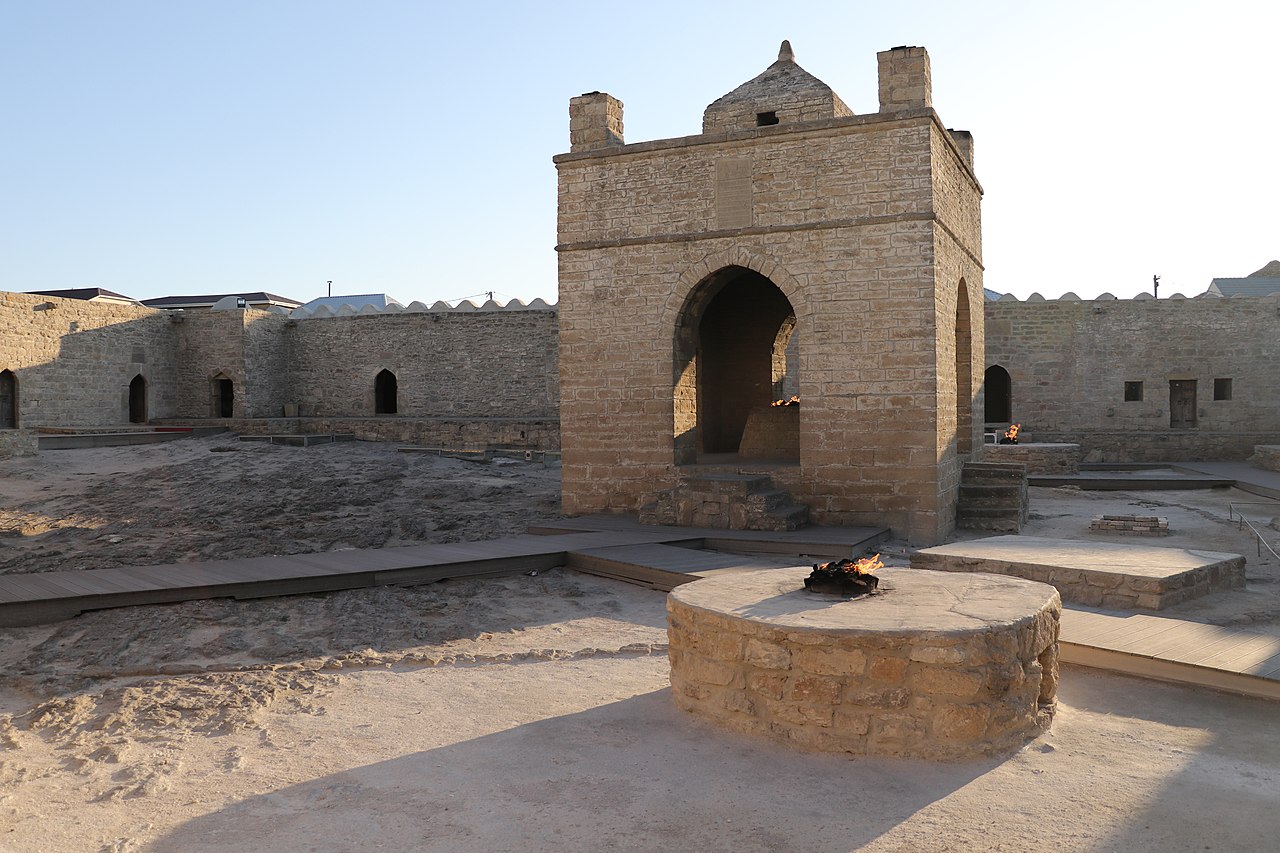
This pentagonal complex was built during the 17th and 18th centuries and has a courtyard surrounded by cells for monks, as well as an altar in the middle. The ateshgah was abandoned in the late 19th century, probably due to the dwindling of the Indian population in the area.
It has been inferred that such fires could be due to “thermal metamorphism” (when rock is heated up by an intrusion of hot magma). However, like the flames of Yanar Dagh, the Ateshgah of Baku’s flame was also due to the seepage of natural gas from porous surface. The natural flow of hydrocarbons at Ateshgah eventually ceased and the natural eternal flame went out in 1969. The flames seen there now are fed from a gas main from the nearby city, for touristic effect – whereas those at Yanar Dagh are still entirely natural.
There are not very many natural fire mountains in the world today and most are located in Azerbaijan. Due to the large concentration of natural gas under the Absheron Peninsula, natural flames have burned there throughout antiquity and have been reported on by historical writers such as Marco Polo.
Yanar Dagh is now the State Historical-Cultural and Natural Reserve, established in 2007. There is also a Yanar Dagh Museum and a Yanar Dagh Cromlech Stone Exhibition.