A trio of archaeologists at the University of Cambridge, in the U.K. conducted a study of hundreds of papers outlining research into hunter-gatherer societies, finding that people in such groups engage in a variety of physical activities. George Brill, Marta Mirazon-Lahr and Mark Dyble published their paper in the journal Proceedings of the Royal Society B: Biological Sciences.
For much of history, male physical and athletic prowess has been considered to be important, while female physical prowess has been mostly overlooked. In this new study, the research team wondered if female physical prowess has also been overlooked in a hunter-gatherer context.
To find out, they conducted a study focusing on research efforts into hunter-gatherer societies—both those in the past and those still in existence today. In all, they looked at more than 900 papers, focusing most specifically on physical or athletic activities of people of both genders.
The research team found that gender has not historically played much of a role in such activities—women ran, swam, climbed trees and dived for food, just as much as men did. The only bias they could find was against women climbing tall trees, and even these instances were rare.
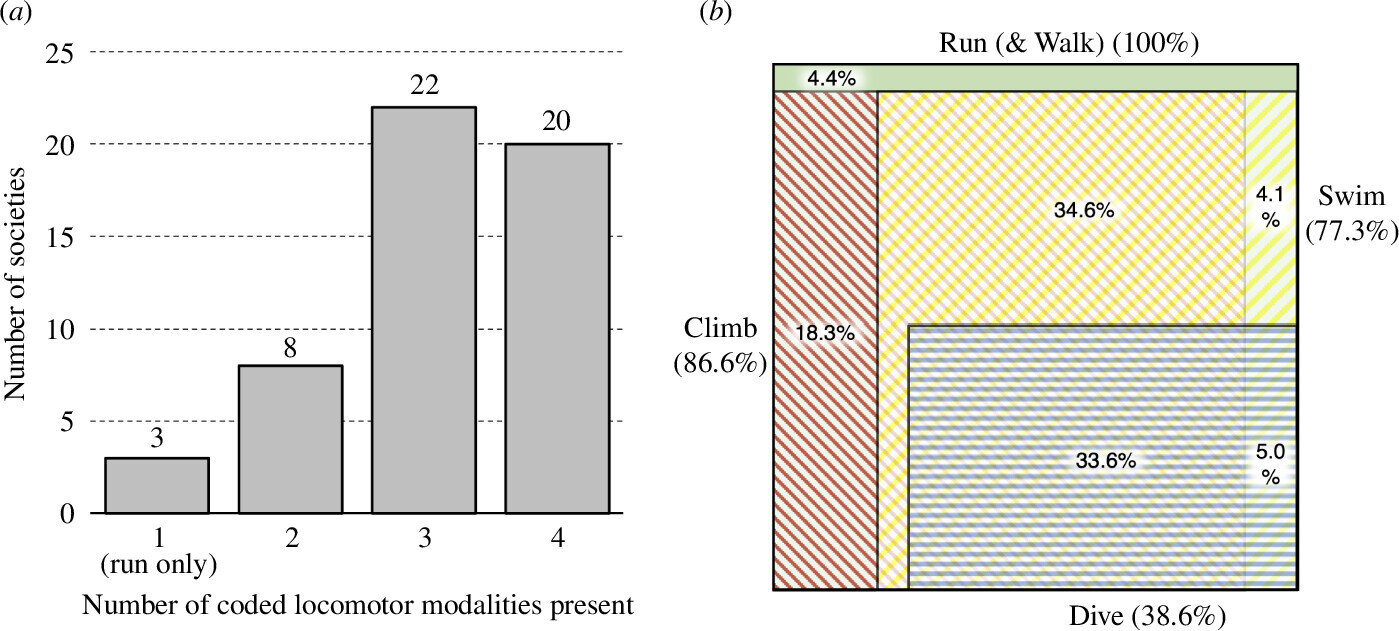
The researchers also noted that hunter-gatherer societies have tended to emphasize physical fitness, likely because it is needed to survive. Thus, in addition to hunting animals or gathering other types of food, many engage in contests or feature physical activities as part of rituals, such as courting. The result has been a high level of physical fitness.
The researchers note that the human form is the result of millions of years of evolution, and modern humans developed mostly as a result of adapting to walking upright and then figuring out how to survive, including activities like running down prey, diving for marine food sources or walking for hours in search of nuts, berries and other sources of food.
They also note that one of the most striking features of human anatomy is the versatility in locomotion. It has allowed humans to adapt to living in grasslands, forests, deserts and the polar regions—practically anyplace on Earth.
This article was first published here.
More information: George Brill et al, Extensive locomotor versatility across a global sample of hunter-gatherer societies, Proceedings of the Royal Society B: Biological Sciences (2024). DOI: 10.1098/rspb.2024.2553
Journal information: Proceedings of the Royal Society B