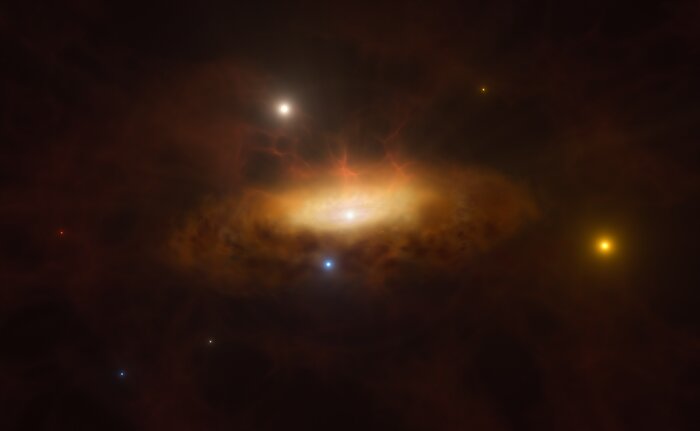
In late 2019 the previously unremarkable galaxy SDSS1335+0728 suddenly started shining brighter than ever before. To understand why, astronomers have used data from several space and ground-based observatories, including the European Southern Observatory’s Very Large Telescope (ESO’s VLT), to track how the galaxy’s brightness has varied. In a study [out in June 2024], they conclude that they are witnessing changes never seen before in a galaxy — likely the result of the sudden awakening of the massive black hole at its core.
“Imagine you’ve been observing a distant galaxy for years, and it always seemed calm and inactive,” says Paula SÁ¡nchez SÁ¡ez, an astronomer at ESO in Germany and lead author of the study accepted for publication in Astronomy & Astrophysics. “Suddenly, its [core] starts showing dramatic changes in brightness, unlike any typical events we’ve seen before.” This is what happened to SDSS1335+0728, which is now classified as having an ‘active galactic nucleus’ (AGN) — a bright compact region powered by a massive black hole — after it brightened dramatically in December 2019.
Some phenomena, like supernova explosions or tidal disruption events — when a star gets too close to a black hole and is torn apart — can make galaxies suddenly light up. But these brightness variations typically last only a few dozen or, at most, a few hundreds of days. SDSS1335+0728 is still growing brighter today, more than four years after it was first seen to ‘switch on’. Moreover, the variations detected in the galaxy, which is located 300 million light-years away in the constellation Virgo, are unlike any seen before, pointing astronomers towards a different explanation.
The team tried to understand these brightness variations using a combination of archival data and new observations from several facilities, including the X-shooter instrument on ESO’s VLT in Chile’s Atacama Desert. Comparing the data taken before and after December 2019, they found that SDSS1335+0728 is now radiating much more light at ultraviolet, optical, and infrared wavelengths. The galaxy also started emitting X-rays in February 2024. “This behaviour is unprecedented,” says SÁ¡nchez SÁ¡ez, who is also affiliated with the Millennium Institute of Astrophysics (MAS) in Chile.
“The most tangible option to explain this phenomenon is that we are seeing how the [core] of the galaxy is beginning to show (…) activity,” says co-author Lorena HernÁ¡ndez GarcÁa, from MAS and the University of ValparaÁso in Chile. “If so, this would be the first time that we see the activation of a massive black hole in real time.“
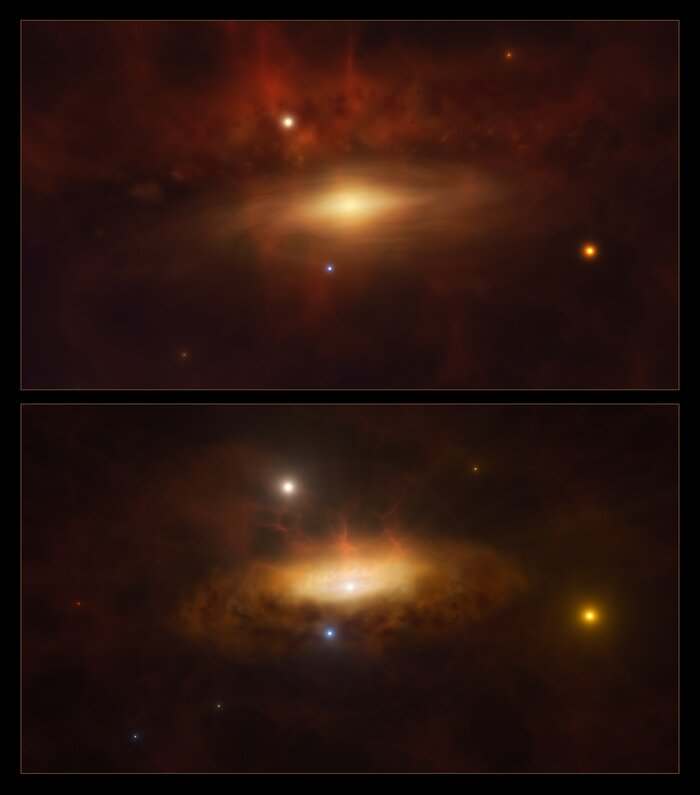
Massive black holes — with masses over one hundred thousand times that of our Sun — exist at the centre of most galaxies, including the Milky Way. “These giant monsters usually are sleeping and not directly visible,” explains co-author Claudio Ricci, from the Diego Portales University, also in Chile. “In the case of SDSS1335+0728, we were able to observe the awakening of the massive black hole, [which] suddenly started to feast on gas available in its surroundings, becoming very bright.“
“[This] process (…) has never been observed before,” HernÁ¡ndez GarcÁa says. Previous studies reported inactive galaxies becoming active after several years, but this is the first time the process itself — the awakening of the black hole — has been observed in real time. Ricci, who is also affiliated with the Kavli Institute for Astronomy and Astrophysics at Peking University, China, adds: “This is something that could happen also to our own Sgr A*, the massive black hole (…) located at the centre of our galaxy,” but it is unclear how likely this is to happen.
(First ever image of our own black hole Sag A* at the centre of the Milky Way Galaxy)
Follow-up observations are still needed to rule out alternative explanations. Another possibility is that we are seeing an unusually slow tidal disruption event, or even a new phenomenon. If it is in fact a tidal disruption event, this would be the longest and faintest such event ever observed. “Regardless of the nature of the variations, [this galaxy] provides valuable information on how black holes grow and evolve,” SÁ¡nchez SÁ¡ez says. “We expect that instruments like [MUSE on the VLT or those on the upcoming Extremely Large Telescope (ELT)] will be key in understanding [why the galaxy is brightening].”
This was originally published as an ESO Press Release.