ESA’s Euclid space mission has revealed its first full-colour images of the cosmos. Never before has a telescope been able to create such razor-sharp astronomical images across such a large patch of the sky, and looking so far into the distant Universe. These five images illustrate Euclid’s full potential; they show that the telescope is ready to create the most extensive 3D map of the Universe yet, to uncover some of its hidden secrets.

This sparkly image shows Euclid’s view on a globular cluster called NGC 6397. Globular clusters are collections of hundreds of thousands of stars held together by gravity.
Located about 7800 light-years from Earth, NGC 6397 is the second-closest globular cluster to us. Together with other globular clusters it orbits in the disc of the Milky Way, where the majority of stars are located.
Globular clusters are some of the oldest objects in the Universe. That’s why they contain a lot of clues about the history and evolution of their host galaxies, like this one for the Milky Way.
The challenge is that it is typically difficult to observe an entire globular cluster in just one sitting. Their centres contain lots of stars, so many that the brightest ‘drown out’ the fainter ones. Their outer regions extend a long way out and contain mostly low-mass, faint stars. It is the faint stars that can tell us about previous interactions with the Milky Way.

To create a 3D map of the Universe, Euclid will observe the light from galaxies out to 10 billion light-years. Most galaxies in the early Universe don’t look like the quintessential neat spiral, but are irregular and small. They are the building blocks for bigger galaxies like our own, and we can still find some of these galaxies relatively close to us. This first irregular dwarf galaxy that Euclid observed is called NGC 6822 and is located close by, just 1.6 million light-years from Earth.
This first irregular dwarf galaxy that Euclid observed is called NGC 6822 and is located close by, just 1.6 million light-years from Earth. It is a member of the same galaxy cluster as the Milky Way (called the Local Group), and was discovered in 1884. In 1925 Edwin Hubble was the first to identify NGC 6822 as a ‘remote stellar system’ well beyond the Milky Way.

Over its lifetime, our dark Universe detective will image billions of galaxies, revealing the hidden influence that dark matter and dark energy have on them.
That’s why it’s fitting that one of the first galaxies that Euclid observed is nicknamed the ‘Hidden Galaxy’. This galaxy, also known as IC 342 or Caldwell 5, is difficult to observe because it lies behind the busy disc of our Milky Way, and so dust, gas and stars obscure our view.
Euclid could take this beautiful and sharp image thanks to its incredible sensitivity and superb optics. Most important here is that Euclid used its near-infrared instrument to peer through the dust and measure the light from the many cool and low-mass stars that dominate the galaxy’s mass.

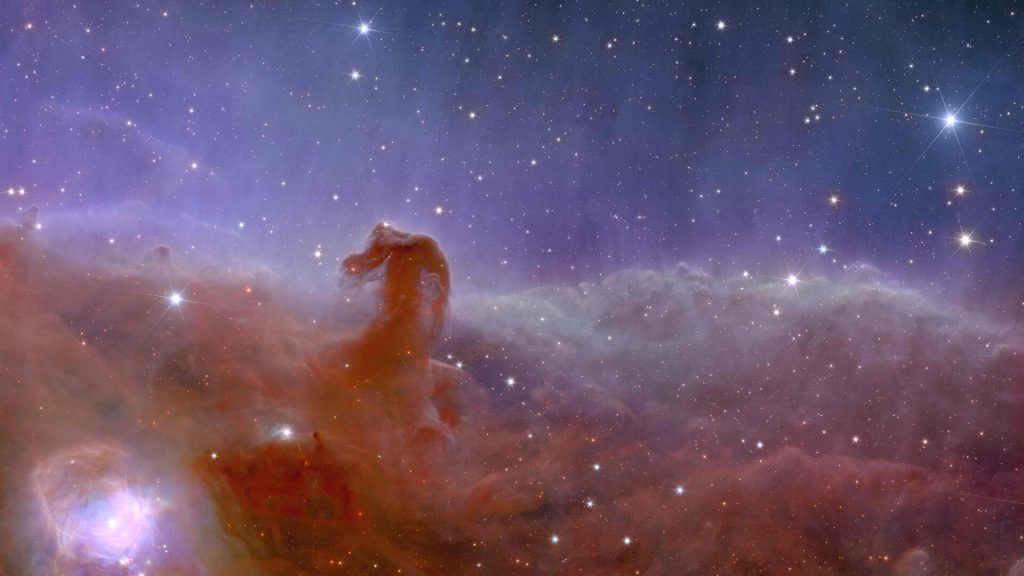
Euclid shows us a spectacularly panoramic and detailed view of the Horsehead Nebula, also known as Barnard 33 and part of the constellation Orion.
At approximately 1375 light-years away, the Horsehead – visible as a dark cloud shaped like a horse’s head – is the closest giant star-forming region to Earth. It sits just to the south of star Alnitak, the easternmost of Orion’s famous three-star belt, and is part of the vast Orion molecular cloud.
Many other telescopes have taken images of the Horsehead Nebula, but none of them are able to create such a sharp and wide view as Euclid can with just one observation. Euclid captured this image of the Horsehead in about one hour, which showcases the mission’s ability to very quickly image an unprecedented area of the sky in high detail.

This incredible snapshot from Euclid is a revolution for astronomy. The image shows 1000 galaxies belonging to the Perseus Cluster, and more than 100 000 additional galaxies further away in the background, each containing up to hundreds of billions of stars.
Many of these faint galaxies were previously unseen. Some of them are so distant that their light has taken 10 billion years to reach us. By mapping the distribution and shapes of these galaxies, cosmologists will be able to find out more about how dark matter shaped the Universe that we see today.
This is the first time that such a large image has allowed us to capture so many Perseus galaxies in such a high level of detail. Perseus is one of the most massive structures known in the Universe, located ‘just’ 240 million light-years away from Earth, containing thousands of galaxies, immersed in a vast cloud of hot gas. Astronomers demonstrated that galaxy clusters like Perseus can only have formed if dark matter is present in the Universe.
Images Credit: ESA
Euclid mission is designed to explore the composition and evolution of the dark Universe. The space telescope will create a great map of the large-scale structure of the Universe across space and time by observing billions of galaxies out to 10 billion light-years, across more than a third of the sky. Euclid will explore how the Universe has expanded and how structure has formed over cosmic history, revealing more about the role of gravity and the nature of dark energy and dark matter. Read more about Euclid