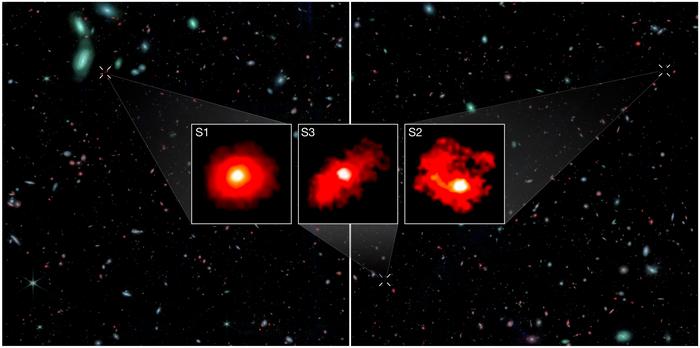
Once again we are in awe of the James Webb Space Telescope (JWST), which has now spotted three gigantic galaxies that scientists are calling “red monsters” from the very early days of our universe. The are so far in the past that they could very well rewrite how we understand the formation of stars and galaxies.
Each of these galaxies is 100 billion times the mass of our sun. In fact they are nearly as big as our own galaxy, the Milky Way – and they are more than 12.8 billion years old. This indicates that they formed just one billion years after the Big Bang. In astronomical terms that is not a long time. The fact that they formed so quickly after the Big Bang means that the stars within them also formed at a rate so fast that they now challange our understanding of how galaxies form.
“Finding three such massive beasts among the sample poses a tantalising puzzle,” study co-author Stijn Wuyts and professor of astronomy at the University of Bath in the U.K., said in a statement. “Many processes in galaxy evolution have a tendency to introduce a rate-limiting step in how efficiently gas can convert into stars, yet somehow these Red Monsters appear to have swiftly evaded most of these hurdles.”
Astronomers have conventionally believed that galaxies form inside giant halos of dark matter, where the immense gravity sucks gas and dust so much that they compress to form stars. This process has been considered ineffiecient because only 20 percent of inward moving gas and dust ends up as stars. The red monsters indicate that 80 percent of their gas converted into bright and young stars.
“These results indicate that galaxies in the early Universe could form stars with unexpected efficiency,” study lead author Mengyuan Xiao, a researcher at the University of Geneva, said. “As we study these galaxies in more depth, they will offer new insights into the conditions that shaped the Universe’s earliest epochs. The Red Monsters are just the beginning of a new era in our exploration of the early Universe.”
The researchers have called them red monsters because of their red glow. They were discovered by the James Webb Telescope’s (JWST) Near Infrared Camera (NIRCam).
“Already in its first few years of operation, JWST has thrown us a couple of curveballs,” Wuyts said. “In more ways than one, it has shown us that some galaxies mature rapidly during the first chapters of cosmic history.”
The astronomers will make further observations of the red monsters using JWST and Chile’s Atacama Large Millimeter Array (ALMA) telescope. And they may have to develop new models of how early galaxies evolved and were able to grow so efficiently.
The researchers published their findings Nov. 13 in the journal Nature.