We are on a mission to talk about all the lesser known celestial objects in our skies. So, today we bring you Haumea, a dwarf planet that lives in the region beyond the orbit of our eighth planet Neptune. Listen on!
-
Haumea has a unique elongated, rugby-ball shape due to its rapid rotation, which causes it to flatten at the poles and stretch at the equator.
-
Its surface is covered with crystalline ice, indicating possible geological activity despite its distance from the Sun.
-
Haumea has two moons (Hi’iaka and Namaka) and a ring system, making it one of the few known dwarf planets with rings.
Hello and welcome to another episode of 360 on History! I’m your host, Saima Baig, and today we’re diving into the fascinating world of lesser-known celestial objects in our skies. Today, we bring you a truly intriguing object—Haumea, a dwarf planet located in the distant region beyond the orbit of Neptune.
Now, Haumea may not be a household name like Pluto or Eris, but it has some mysteries that are sure to capture your imagination. Let’s go back to 2004, when Haumea was first discovered by a team from the Palomar Observatory at Caltech. However, it wasn’t until 2005 that the discovery was formally announced by a team led by JosÁ© Luis Ortiz Moreno at the Sierra Nevada Observatory in Spain, using images from 2003. Initially, Haumea was given the provisional designation 2003 EL61, but the object would soon get its official name.
Haumea was named after the Hawaiian goddess of childbirth and fertility on September 17, 2008. But here’s a fun fact: Before Haumea had a permanent name, the discovery team affectionately called it “Santa,” because it was first sighted on December 28, 2004—just after Christmas!
Haumea’s story is not just about its discovery—it’s about the mysteries surrounding its shape, its moons, and its role in the outer reaches of our solar system. Estimated to be the third-largest known trans-Neptunian object, Haumea’s size is comparable to Uranus’s moon, Titania. Its mass is about one-third of Pluto’s and about 1/1400th of Earth’s. Its equatorial diameter is roughly 1,080 miles, making it about one-seventh the size of Earth.
Now, let’s talk about its distance from the Sun. Haumea orbits at an average distance of about 4 billion miles, or 6.5 billion kilometers. This places it 43 astronomical units away from the Sun. To put that in perspective, it takes sunlight 6 hours to travel that far.
Here’s where things get even more interesting. Haumea has a shape that defies what you might expect from most celestial bodies. It’s not round like Earth or the Moon—Haumea is an ellipsoid, stretching out like a rugby ball. This unusual shape is due to its rapid rotation—it spins so fast, completing one full rotation in just 4 hours! This fast spin causes it to stretch at the equator, forming that rugby-ball shape.
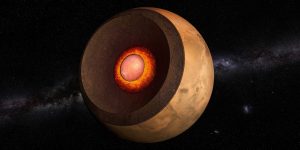
Astronomers believe Haumea is made of rock with a coating of ice, and its rapid rotation makes it one of the fastest rotating large objects in the entire solar system. It’s so fast that it’s almost as if Haumea is constantly on the go. In fact, Haumea takes a staggering 285 Earth years to orbit the Sun, completing one rotation every four hours during that time.
It’s also thought that Haumea’s current shape might have resulted from a massive collision billions of years ago, setting off its fast rotation and even creating its moons. Speaking of moons, Haumea has two: Namaka and Hi’iaka. Both moons were discovered in 2005 and named after Haumea’s daughters in Hawaiian mythology. Namaka is a water spirit, while Hi’iaka is the goddess of hula dancers and the island of Hawaii. These moons, along with the dwarf planet itself, belong to a group of objects found in the Kuiper Belt—a vast region beyond Neptune, filled with icy worlds.
Haumea is not just a strange shape—its surface holds some surprises too. The dwarf planet’s surface is as bright as snow, reflecting sunlight almost like fresh snow does here on Earth. In fact, 66% to 80% of its surface appears to be made of pure crystalline water ice, with traces of hydrogen cyanide and possibly some clay minerals. Haumea’s bright, icy surface is a reminder of the extreme conditions in the outer solar system.
And here’s one of the most exciting discoveries: Haumea has a ring system. This was announced in October 2017, when astronomers observed Haumea passing in front of a star. This made Haumea the first trans-Neptunian object, and the first dwarf planet, to be discovered with a ring system. Quite a remarkable achievement for an object so far from the Sun!
Haumea’s discovery and the ongoing research surrounding it continue to shed light on the distant reaches of our solar system. From its unusual shape to its moons, rings, and icy surface, Haumea is one of the most intriguing objects beyond Neptune.
That’s all for today’s episode of 360 on History. I hope you enjoyed learning about Haumea, and its fascinating role in the Kuiper Belt. Join me next time as we continue to uncover the lesser-known celestial objects that fill our universe. Until then, I’m Saima Baig, and you’ve been listening to 360 on History. Stay curious and keep exploring! And while you do that please do check out our website 360onhistory.com, our YouTube channel 360onhistory and all our social media.
Please subscribe to the You Tube Channel for more on science, history and nature and please do check out the website and follow on social media: Twitter // Instagram // Facebook // Reddit // Threads
Podcast: Play in new window | Download