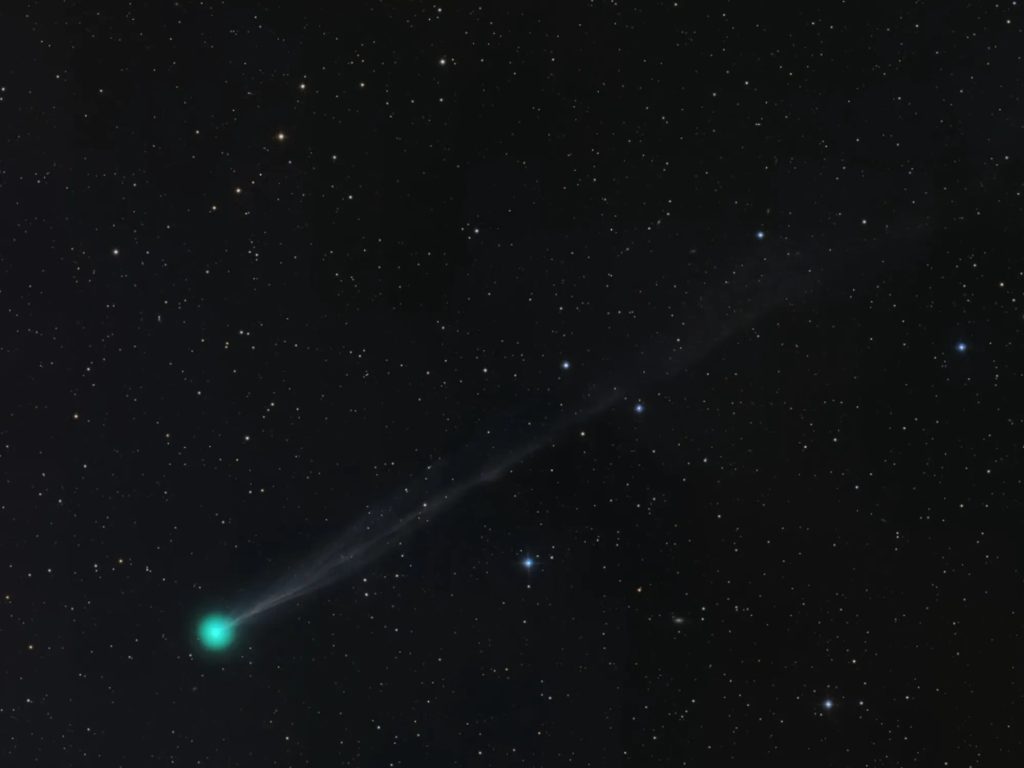
Comet C/2025 F2 (SWAN) is visiting our night sky, growing green as it orbits our Sun. It is visible in the early morning hours in the Northern Hemisphere.
The comet is named after SWAN, a camera aboard the Solar and Heliospheric Observatory (SOHO) spacecraft, which first detected it.
Comets are bodies of rock, dust and ice left over from the formation of our universe. When they pass close to the sun, they warm up, and give off a cloud of gas and dust that glows and forms a tail.
Since its discovery C/2025 F2 (SWAN) has become brighter as it approaches perihelion. This is the closest point to the sun in its orbit, and which will happen on May 1.
If it continues to brighten, the comet might even become visible to the naked eye. On the other hand, it is also possible that the comet could break apart when it nears the sun.
The green coma [the comet’s dusty glow] is due to diatomic carbon being ejected from the comet’s surface, which is usually not visible because sunlight destroys diatomic carbon.
The comet will remain visible via binoculars and telescopes shortly before sunrise in the northern hemisphere till April 25. After this date it will be visible after sunset on the west-northwest horizon, and will probably disappear after May 5.
Don’t worry Southern Hemisphere, you can see C/2025 F2 (SWAN) around May 4.
I haven’t seen it yet but it might be worth a late night because C/2025 F2 (SWAN) orbits the sun once every 1.4 million years, so it wont be back any time soon!